

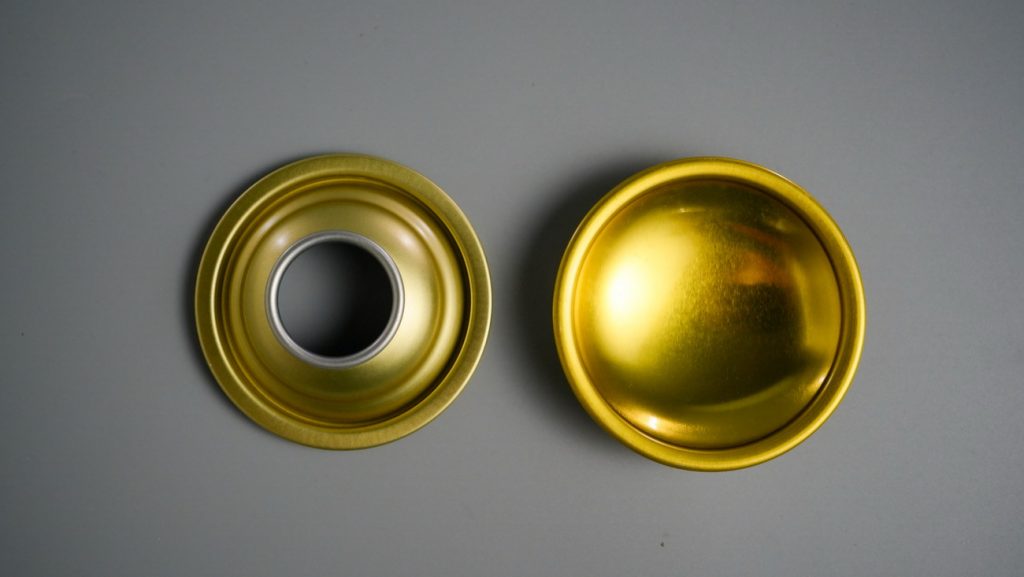
Many procurement and quality control personnel often encounter a tricky inspection problem: customized golden tinplate aerosol cans and silver high-gloss cans feature perfect luster and flawless appearance when leaving the factory. However, after long-distance transportation, the can surface turns whitened and hazy with foggy white spots, looking like aged old products. This issue usually leads to severe consequences including full-container rejection, rework compensation and even supplier elimination from the brand’s supply chain. Most partners will first suspect ink quality defects upon receiving goods. Yet professional on-site tests always confirm that the ink layer maintains perfect adhesion, abrasion resistance and color fastness. Whitening and hazing on the exterior of printed tinplate cans is never caused by ink problems; the hidden danger lies entirely in the white primer blanking process during printing.
To create a high-end mirror metallic texture, most custom tinplate aerosol cans for daily chemicals, fragrances and personal care products adopt the white primer blanking process for gold and silver printing areas. Simply put, the bottom white primer coating is omitted, allowing metallic ink to directly adhere to the tinned tinplate substrate. Many processing factories consider this process a way to simplify procedures and reduce costs, but ignore its fatal defects in complex transportation environments — the core cause of repeated inspection failures and appearance deterioration.
In standard tinplate printing processes, a layer of white primer is evenly coated on the metal surface. This coating not only enhances color saturation, but more importantly seals micro-pores and levels the rough tinplate substrate, providing a stable base for the upper ink layer. The white primer blanking process completely abandons this protective layer. High-gloss gold and silver metallic ink contains a high proportion of metallic pigments and low resin binder content, making it impossible to form a dense and complete paint film naturally.
In high-humidity and slightly salt-fog transportation environments, tiny water vapor and corrosive media penetrate through micro-pores of the paint film, directly contacting the tin and iron substrate of tinplate. This triggers slow electrochemical oxidation reactions, forming visible oxidized white spots and foggy haze, which eventually dull the luster of high-gloss metallic ink tinplate aerosol cans. This micro-pore-induced corrosion is professionally defined as filiform corrosion in the metal packaging industry. The fundamental solution to avoid permanent appearance damage is not passive surface protection, but actively blocking electrolyte penetration through the thin white primer base process.
Whitening Causation Chain (Core Mechanism Overview): White primer blanking → Sharp increase in paint film porosity → Penetration of moisture and salt fog → Electrochemical filiform corrosion on tin layer → White spots and gloss loss on can surface
In fact, most repeated quality disputes stem from focusing only on surface ink and varnish, while ignoring the decisive role of the underlying process structure. The two mainstream printing processes differ greatly not only in technical parameters, but also in corresponding commercial risks, inspection pass rates and supply chain stability.
| Comparison Dimension | Full White Primer Process | White Primer Blanking Process | Typical Commercial Risks |
|---|---|---|---|
| Gloss Loss After 72h Salt Spray Test | Gloss reduction <5%, no obvious appearance change | 30%-40% gloss loss, obvious widespread surface hazing and whitening | Full white primer: Ultra-low risk, suitable for long-term branded mass supply |
| Overall Paint Film Stability | Dense and uniform paint film with excellent adhesion, weather resistance and moisture resistance | Dense micro-pores in paint film, weak salt spray and humidity resistance | White primer blanking: High risk! Prone to unqualified arrival inspection, full-container rejection, damaged brand shelf image, additional high costs of emergency rework and air freight, and even loss of long-term cooperative orders |
| Can Adaptability | Controllable ductility, compatible with most regular and deep-drawn can types | Paint film easily thins and exposes the metal base after stretching, high failure rate for deep-drawn cans | |
| Applicable Supply Scenarios | Long-term mass shipment, long-distance transportation, high-end brand customized orders | Only suitable for short-distance turnover, trial orders and low appearance requirement orders |
With years of industry experience, SAILON has witnessed numerous quality control accidents caused by cost-cutting white primer blanking processes. Simply upgrading ink, thickening varnish or improving substrate can only provide temporary relief rather than fundamental solutions to filiform corrosion. To solve the industry pain point of gloss loss and whitening of mirror gold and silver finish tinplate aerosol cans during long-distance transportation, we have developed a mature “Sandwich” Closed-Loop Protection Process that blocks corrosion in all links while retaining high-end metallic texture:
- Base Layer Sealing Protection: Adopt ultra-thin full-coverage white primer coating to completely seal the tinplate metal base, physically block the penetration channel of water vapor, salt fog and electrolytes, and eliminate the inducement of filiform corrosion from the source.
- Middle Layer Color Fixing: Adopt double-layer dense special metallic ink overprinting to ensure high paint film density while restoring high-brightness gold and silver metallic luster without compromising high-end visual effect.
- Surface Layer Water Resistance Reinforcement: Spray high-crosslinking top varnish and form a high-density protective film through high-temperature cross-linking and curing to further enhance moisture and salt spray resistance.
- Final Verification Closed Loop: All finished batches must pass a 48-hour combined damp heat and salt spray cycle test, simulating the harshest long-distance transportation conditions. Products are only delivered with no white spots, gloss loss or delamination, completely avoiding inspection failures.
Since the implementation of this closed-loop process, multiple batches of premium gold and silver finish tinplate aerosol cans delivered by us have achieved zero whitening, zero gloss loss and zero inspection disputes. This process has been designated as a fixed quality standard by many brand customers, perfectly balancing high-end texture and transportation stability.
FAQ
Q: Can tinplate with higher tin content completely solve the problem of can whitening?
A: No. High-tin-content substrate can only slightly slow down the corrosion rate, but cannot eliminate the root cause. Without the sealing protection of white primer, corrosive media will bypass the tin layer and penetrate along metal grain boundaries, still causing filiform corrosion, white spots and gloss loss. It is only a temporary remedy with no fundamental effect.
Q: Can excessively thickening the outer transparent varnish make up for the defects of the white primer blanking process?
A: It solves one problem but creates new risks, and is absolutely inadvisable. Thickened varnish only improves temporary surface waterproof performance. Excessively thick coating will crack and peel during can crimping and sealing, forming new weak leakage points. The correct solution is the coordinated protection of “thin white primer base + standard-thickness high-crosslinking varnish”, rather than blind single-layer thickening.
Q: Is there a quick detection method to predict whitening and gloss loss of cans after long-distance transportation?
A: Yes. A single salt spray test is overly strict and inconsistent with real transportation conditions. The industry’s most accurate method is a 48-hour combined damp heat and salt spray cycle test, which simulates real high-temperature, high-humidity and salt fog transportation working conditions. Cans with no white spots and negligible gloss loss after testing are confirmed stable for long-distance delivery.
Q: Does the blanking process for matte gold and silver cans also carry whitening and gloss loss risks?
A: Yes, but with lower risks. Matte metallic ink has finer pigment particles and fewer paint film pores, so it is less prone to problems in short-distance transportation. However, filiform corrosion will still occur in long-term high-humidity environments. For matte tinplate aerosol cans, we appropriately adjust the white primer thickness and baking time to balance texture and weather resistance.
Specializing in custom tinplate aerosol cans, SAILON is equipped with fully automatic coating production lines and complete environmental simulation testing equipment. We customize exclusive anti-whitening and anti-gloss-loss process solutions for different can types, transportation scenarios and texture requirements. With full-process closed-loop control covering pre-production sampling and process customization, mass production quality control and ex-factory aging verification, we help customers completely avoid inspection disputes and supply chain losses, and maintain the high-end appearance of branded products.