

Imagine shipping 20,000 units of your high-performing rust converter spray, only to get urgent calls from distributors three weeks later: the cans are pin-leaking, the formula has turned black, and the bottom seals are falling apart. For aerosol packaging engineers and chemical brand owners, acid-induced internal coating failure is a costly nightmare. Standard aerosol tin cans simply aren’t built to hold formulas with a pH between 3.0 and 5.0.
Here is what happens inside an acidic rust converter aerosol tin can at the microscopic level—and how engineered epoxy-phenolic coating tinplate technology prevents catastrophic batch recalls.
The Acid Attack: How Low pH Formulas Liquidate Standard Inner Coatings
Most active rust converters rely on organic acids or phosphoric acid derivatives to reduce iron oxide ($\text{Fe}_2\text{O}_3$) into a stable, paintable iron phosphate complex. While great for rusted steel, these active acid ions are aggressive against aerosol packaging.
The Microscopic Failure Mechanism:
- Micro-Pores: Standard single-pass internal lacquers leave microscopic pinholes during high-speed spray application.
- Tin-Iron Galvanic Cell: Acid leaks through these pores and attacks the soft tin layer on the tinplate. Once tin dissolves, it creates a local galvanic cell with the underlying raw iron.
- Accelerated Crevice Corrosion: The acid concentrates inside this tight micro-gap, causing rapid tinplate crevice corrosion. Within days, you get deep pinholes, iron leaching (turning the product dark), and container leaks.
The Barrier Solution: SAILON’s Double-Pass Epoxy-Phenolic Technology
To withstand continuous acid exposure, packaging requires more than just a thicker coat—it demands a chemical-resistant matrix.
1. High-Density Epoxy-Phenolic Resin
Unlike standard acrylic or polyester linings, high-crosslinking epoxy-phenolic resin offers extreme resistance to low-pH solvents, preventing organic acids from swelling or breaking down the polymer chains.
2. Double-Pass Coating Process
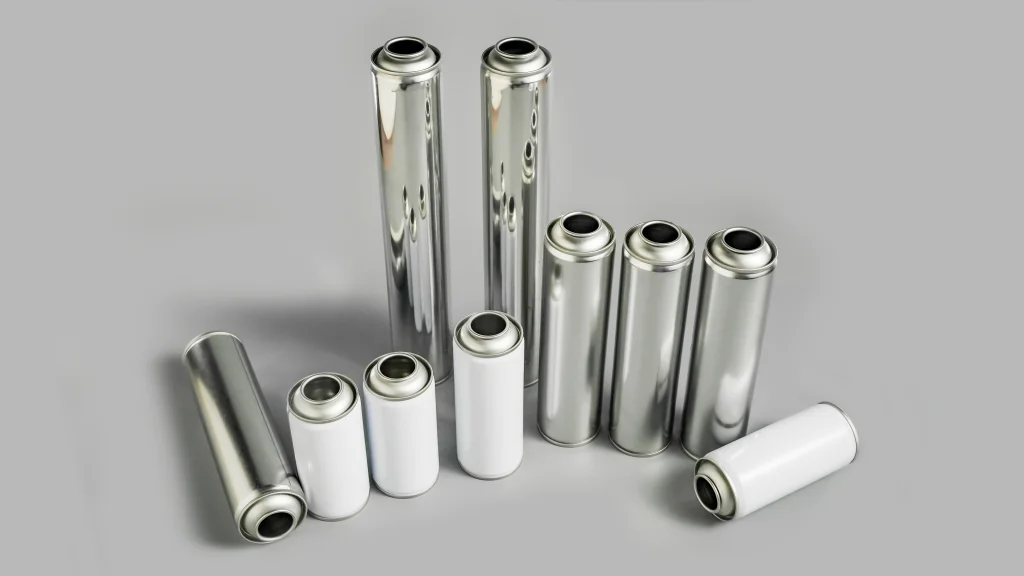
Instead of a single spray coat, SAILON acid resistant aerosol tin cans undergo a two-step application:
- First Pass: Seals the bare metal substrate and levels out surface irregularities.
- High-Temp Curing: Cross-links the first layer into a rigid polymer base.
- Second Pass: Covers any lingering micro-voids, creating a continuous, pore-free dielectric barrier.
3. Zero-Pinhole Quality Control: 0 mA Leakage
To guarantee reliability before liquid filling, every batch undergoes strict porosity test aerosol packaging protocols. High-voltage spark testing ensures an electrical leakage current of 0 mA, proving zero micro-porosity across the inner wall.
90-Day Acid Resistance Test Data
We put standard cans and SAILON Double-Pass Epoxy-Phenolic Aerosol Tin Cans through an accelerated 90-day immersion test using active acidic rust conversion formulas.
| Formula pH Level | Standard Single-Coat Aerosol Tin Can | SAILON Shield (Double-Pass Epoxy-Phenolic) |
| pH 5.0 (Mild Rust Converter) | Pinhole corrosion and edge rusting at Day 30 | Zero corrosion, coating intact after 90 days |
| pH 3.5 (Heavy-Duty Conversion) | Coating peeling, formula blackening within 14 days | Zero perforation, no blistering after 90 days |
Stop Replacing Cans. Start Shielding Your Chemical Formulas.
If you are formulating acidic rust treatments, standard off-the-shelf aerosol tin cans are a quiet liability waiting to erupt on retailer shelves. Achieving reliable tinplate crevice corrosion protection requires specialized lining chemistries engineered specifically for low-pH stability.
Need certified acid-resistant packaging samples for lab testing? Talk to our technical team today to evaluate SAILON acid resistant aerosol tin cans against your toughest chemical formulas.