

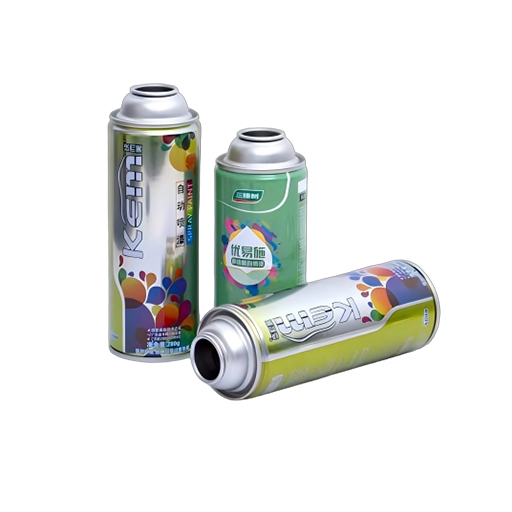
A while ago, I received a client who slammed a box of Skincare Aerosol Tin Cans on the table as soon as he walked in—there were rust spots all over the bottom, and the moisturizing mist inside had turned turbid after only two months. He said, “I’ve changed two suppliers and it’s still like this; is there something wrong with our formula?” To be honest, this isn’t the formula’s fault, nor is it the tinplate’s—it all comes down to choosing the wrong internal coating for high-active skincare aerosol tin cans, a pitfall that 80% of brands in the industry will step into.
Don’t doubt it—the “good stuff” in skincare products is precisely the culprit behind corrosion. High-concentration vitamin C and fruit acid ingredients, most with a pH below 4, are like small acid knives that slowly “gnaw” through the internal coating; even alcohol-containing sunscreen sprays can make the coating lose elasticity, cracking and leaking over time. What’s more troublesome is that many brands only look at coating parameters but ignore the hidden ingredients in the formula—for example, the plant extracts in a repair mist, which seem gentle but can react chemically with the coating, a point rarely mentioned in skincare aerosol tin can coating adaptation guides.
SAILON has been doing customization for more than ten years, and we’ve long figured out the tricks here. Most of the time, it’s not that the coating quality is poor, but that the right one isn’t chosen. I’ve sorted out a highly practical selection table for you, with notes on the pitfalls we’ve stepped on:
| Coating Type | Suitable Formula pH Range | Tolerant Core Ingredients | Pitfall Warning (Personal Experience) | Suitable Products |
|---|---|---|---|---|
| Epoxy Phenolic | 4.0-9.0 | Medium-low concentration Niacinamide, Vitamin E, Humectants | Avoid high-concentration fruit acids—peeling is likely | Basic moisturizing sprays, setting sprays |
| Organosol (Polyurethane) | 3.5-10.5 | High-concentration fruit acids, Vitamin C, Plant Extracts | Durable but control costs—don’t use if not necessary | Exfoliating sprays, high-efficiency repair sprays |
| Double-Layer Composite Coating (SAILON Custom) | 3.0-11.0 | Mixed active ingredients, alcohol-containing formulas | For complex formulas, 100% test pass rate | High-end functional skincare sprays |
To be honest, choosing the right coating is only the first step—anti-corrosion testing for skincare aerosol tin cans is a must, which is a iron rule at SAILON:
- First, conduct an “immersion test” with formula samples and the coating, soak at room temperature for 14 days to check if the coating turns white or bulges
- Then do accelerated aging: place at 45℃ for 28 days to simulate 18 months of product storage
- Finally, shake the can test to simulate vibration during transportation and avoid coating peeling due to friction

Someone asked, “We have no corrosion in small-batch trial production—will mass production be okay?” It will most likely go wrong. During small-batch testing, the reaction between the formula and the coating hasn’t fully manifested; during mass production, large-scale filling and long-term stacking will amplify corrosion exponentially. We once helped a brand rework because they skipped the accelerated test, resulting in 100,000 cans of spray being recalled due to corrosion, with losses exceeding one million.
Q: We make exfoliating sprays with double acids—what coating is reliable?
A: The pH of double acids is usually around 3.0, which ordinary Organosol coatings can’t withstand. It’s recommended to choose SAILON’s double-layer composite coating; we add an acid-resistant isolation film at the bottom. We’ve solved similar problems for customers in the same category, and there have been no corrosion complaints so far.
Q: Is the thicker the coating, the better the anti-corrosion effect?
A: On the contrary, it may be worse. Too thick a coating will be brittle and easy to crack during transportation. Most of the time, a thickness of 0.015-0.02mm is just right—the key is uniformity. SAILON uses electrostatic spraying technology, and the coating thickness error can be controlled within 0.002mm.
In fact, the core of customized skincare aerosol tin cans is to first understand your own formula, then find the right coating. Over the years, SAILON has seen too many brands rework due to corrosion, so we set a rule: no matter how big the order is, we first help customers do compatibility testing between the formula and the coating for free, then determine the production plan. After all, for a brand, a corroded spray doesn’t just ruin a product—it also destroys consumer trust—and that’s the most valuable thing.