

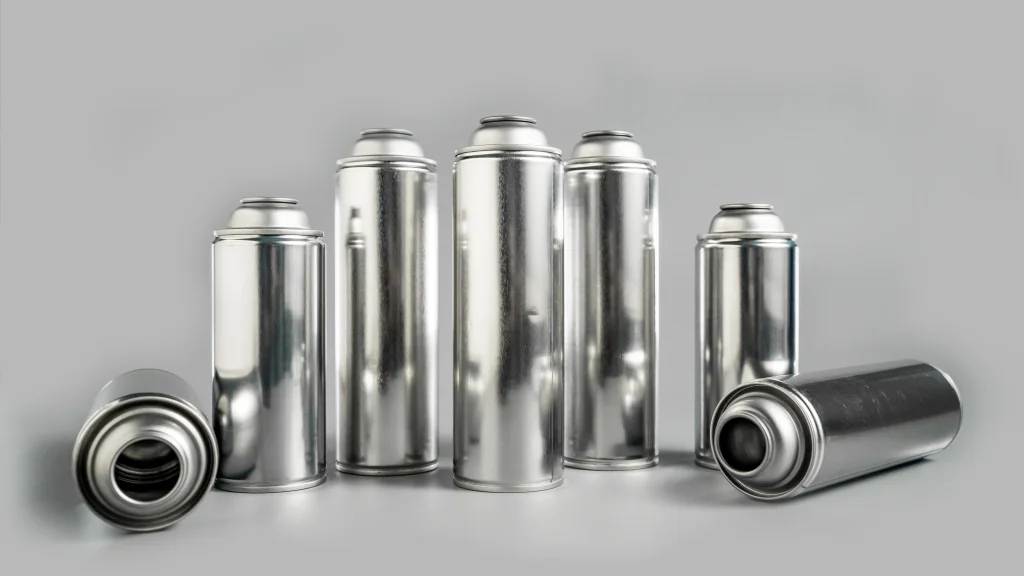
Sourcing empty aerosol tin cans for products like brake cleaners, spray paints, sunscreen sprays, and lubricants can be challenging for B2B procurement teams. Overlooking key technical parameters often leads to container deformation, leakage, or unnecessary costs due to over-specification. Mastering these 5 core metrics will help you source high-quality custom aerosol tinplate cans and streamline your purchasing decisions.
I. 5 Core Parameters: Pitfall Avoidance Breakdown
1. Net Fill Volume ≠ Brimful Capacity
- Common Mistake: Ordering a 500ml capacity can to hold 500ml of liquid.
- Pro Tip: Aerosol containers require 15% to 20% headspace for propellant expansion and safety buffering. Overfilling can cause liquid expansion under warm conditions (e.g., inside cargo trucks reaching 50°C), triggering the bottom dome release or leakage.
- Quick Formula: Required Brimful Capacity = Target Liquid Volume ÷ 0.8
2. Pressure Ratings: Deformation vs. Burst Pressure
Aerosol containers are regulated pressure vessels subject to strict customs inspections and dangerous goods (UN) transport standards:
- Deformation Pressure: The threshold where the bottom dome begins to buckle outward. Standard cans require ≥ 1.2 MPa, while a high pressure tin aerosol container (e.g., brake cleaners, technical sprays) requires ≥ 1.35 – 1.5 MPa.
- Burst Pressure: The ultimate pressure limit at which the welded seam bursts. Standard cans require ≥ 1.4 MPa, whereas high-pressure specifications require ≥ 1.8 MPa.
3. Inner Coating Selection
Selecting the right inner lining protects against formula corrosion and extends shelf life. The right choice prevents leaks without exceeding your budget:
| Formula Type | Coating Choice | Key Takeaway |
| Pure Oil / Non-Solvent (Engine oil, grease, chain oil) | Plain Can (Uncoated) | Lowest cost; no internal coating fee required. |
| Strong Solvents (Brake cleaners, acetone) | Epoxy-Phenolic Double Coating | Standard linings peel off in strong solvents, clogging spray nozzles. |
| Water-Based / Alcohol / Weak Acid (Sunscreen sprays, waterborne paint) | Organosol / Modified Polyester | Water triggers electrochemical corrosion; double-layer sealant is mandatory. |
4. Tin Coating Weight (Rust Resistance)
Tinplate rust resistance depends on the tin plating weight on the steel base (typically formatted as E2.8/E2.8, meaning 2.8 g/m² tin coating on both internal and external surfaces):
- Inland / Oil Formulations: E1.1/E1.1 or E2.8/E2.8 is sufficient.
- High Humidity / Ocean Freight / Water Formulations: Specify E2.8/E2.8 or higher to prevent salt spray and moisture from rusting the outer tinplate during maritime transit.
5. Opening Size & Can Structure
- Standard Opening Size: 99% of global aerosol tin cans feature a standard 1-inch (25.4mm) opening, compatible with standard 1″ valves and actuators.
- Mainstream Can Types:
- Necked-in Can: Top and bottom seams do not bulge out beyond the body width. Offers optimal pallet stacking, saves freight space, and provides the highest cost efficiency.
- Straight-side Can: Completely flush body line with seamless 360° printing display, ideal for luxury cosmetics or automotive touch-up paints.
II. Quick Procurement Checklist
- Calculate Capacity: Confirm net fill volume and apply formula (
÷ 0.8) for brimful capacity. - Verify Pressure: Choose standard pressure (1.2/1.4 MPa) or high pressure (1.35/1.8 MPa) based on propellant specs.
- Match Coating: Plain cans for oil, Epoxy-Phenolic for strong solvents, Organosol for water-based formulas.
- Specify Anti-Rust: Select E2.8/E2.8 tin coating weight for ocean freight and export.
III. Frequently Asked Questions (FAQ)
Q1: How do I know if my product requires a high pressure tin aerosol container?
A: If your formulation utilizes high-pressure propellants (such as DME or propane/butane blends) or requires storage ratings above 50°C, you must specify a deformation pressure of ≥ 1.35 MPa and a burst pressure of ≥ 1.8 MPa.
Q2: What should I keep in mind regarding graphic printing for custom aerosol tinplate cans?
A: Necked-in cans have a subtle curvature near the shoulder, so design artwork should keep key text and QR codes away from the crimped seams and necked areas. Straight-side cans allow seamless 360° visual displays.