

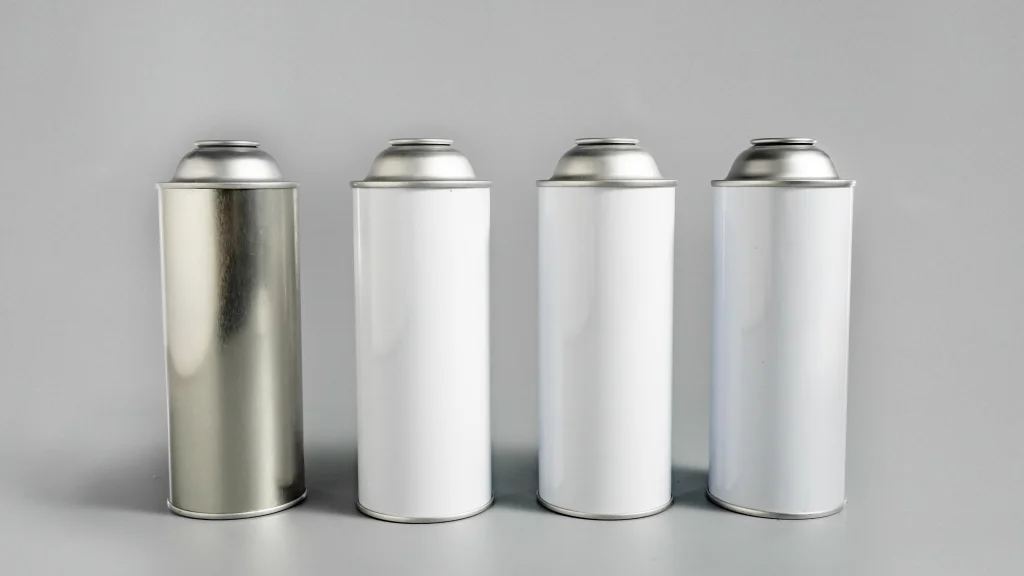
Why Do Custom Aerosol Can Quotes Vary So Drastically?
When sourcing custom tinplate aerosol cans from global suppliers, B2B procurement managers are often puzzled by widely differing unit price quotes for what appears to be the same size can. A difference of $0.02 to $0.05 per unit may seem minor at first glance, but across a 500,000-can annual order, it represents tens of thousands of dollars in profit margin.
Understanding the underlying cost drivers is key to budget optimization. Unit costs are shaped by specific engineering specs, raw material grades, and production efficiencies. Here are the 5 hidden factors that impact custom aerosol tin can unit costs and practical strategies to reduce your packaging spend without compromising safety.
1. Tinplate Thickness and Steel Grade
Tinplate isn’t just “metal”—it comes in various thickness gauges (typically ranging from 0.19 mm to 0.28 mm) and temper classifications (e.g., T2.5, T3, T4, or DR steels).
- Thicker Plate = Higher Pressure Rating: High-pressure aerosol cans (e.g., butane gas, industrial lubricants) require thicker plate, increasing raw material weight and cost.
- Cost Saving Tip: For normal-pressure formulation (e.g., air fresheners, party strings), select optimized neck-in designs that maintain structural integrity while utilizing standard-gauge tinplate.
2. Minimum Order Quantity (MOQ) and Line Efficiency
Custom tinplate printing requires complex press set-up, plate making, and color calibration.
- Set-up Waste: A short production run (e.g., 10,000 units) spreads high prepress setup costs over few cans, resulting in higher unit prices.
- Cost Saving Tip: Consolidate multiple SKUs using standardized can dimensions (e.g., Diameter 65mm) in a single printing batch to reach 30,000–50,000 unit tiers for maximum scale economies.
3. Printing Technology & Spot Color Count
Whether you opt for standard CMYK (4-color process) or multi-spot PMS colors significantly alters coating pass requirements.
- Special Finishes: Matte varnishes, metallic spot inks, and tactile soft-touch coatings require additional roller passes and baking cycles.
- Cost Saving Tip: Design artwork around 4-color process (CMYK) plus 1 spot color rather than 6+ independent spot colors to reduce roller passes.
4. Cone & Dome Material Specifications
The top cone and bottom dome account for a significant portion of total metal mass.
- Pre-coated vs. Plain Components: High-pressure top cones or specialized golden/white coated caps carry higher material costs than plain standard domes.
- Cost Saving Tip: Standardize dome finishes across your product lineup to benefit from bulk component manufacturing.
5. Specialized Internal Coatings (Inner Lacquer)
Not all formulations require inner lacquering, but reactive chemicals demand specialized anti-corrosion protection.
- Coating Types: Plain unlined cans cost less than epoxy-phenolic, polyamide-imide, or water-based inner coated cans.
- Cost Saving Tip: Conduct chemical compatibility testing early; don’t over-spec anti-corrosion lacquers for inert, oil-based formulations.
Aerosol Can Cost Optimization Matrix
| Cost Factor | High-Cost Driver | Budget-Optimized Alternative | Potential Savings |
| Order Volume | Small runs (<10,000 pcs) | Standard batch runs (30,000–50,000+ pcs) | 15% – 25% |
| Printing | 6+ Spot colors + Matte finish | CMYK + Gloss Varnish | 8% – 12% |
| Tinplate Spec | Over-engineered thick plate | Standard DOT-compliant gauge | 5% – 10% |
| Inner Coating | Double-coat inner lacquer (for oil formulation) | Unlined plain plate (where formula permits) | 6% – 10% |
B2B Buyer’s Cost Reduction Checklist
- [ ] Standardize Diameters: Stick to industry-standard diameters (e.g., Ø45mm, Ø52mm, Ø60mm, Ø65mm, Ø70mm) to avoid tooling fees.
- [ ] Optimize Artwork: Consult with the supplier’s pre-press department to convert unnecessary spot colors to CMYK gradients.
- [ ] Forecast Demand: Share quarterly volume forecasts with your factory to lock in raw tinplate material prices.
- [ ] Audit Supplier Certifications: Work directly with integrated tinplate printing and can-making manufacturers (avoid trading middleman markups).

Frequently Asked Questions (FAQ)
Q1: What is the typical MOQ for custom printed aerosol tin cans? For custom offset lithographic printing, standard MOQs usually range from 30,000 to 50,000 pieces per design, matching optimal tinplate printing sheet yields.
Q2: Does choosing a neck-in can cost more than a straight-body aerosol can? Neck-in cans require additional necking station operations, but they optimize space and stacking efficiency during palletization and ocean shipping, often lowering total logistics cost.
Q3: How do raw metal price fluctuations affect my long-term contract pricing? Direct manufacturers like SAILON purchase tinplate raw coil in bulk, enabling lock-in pricing mechanisms for established long-term procurement agreements.
Partner with SAILON for Transparent, Cost-Effective Packaging
At Foshan SAILON Tinplate Printing & Can Making Co., Ltd., we operate as a direct, integrated manufacturer combining tinplate trading, printing, and automated can-making under one roof. With 10 advanced printing production lines and 8 high-speed automated can-making lines across 50,000 M², we eliminate middleman costs and provide transparent pricing tailored to your target unit budget.