

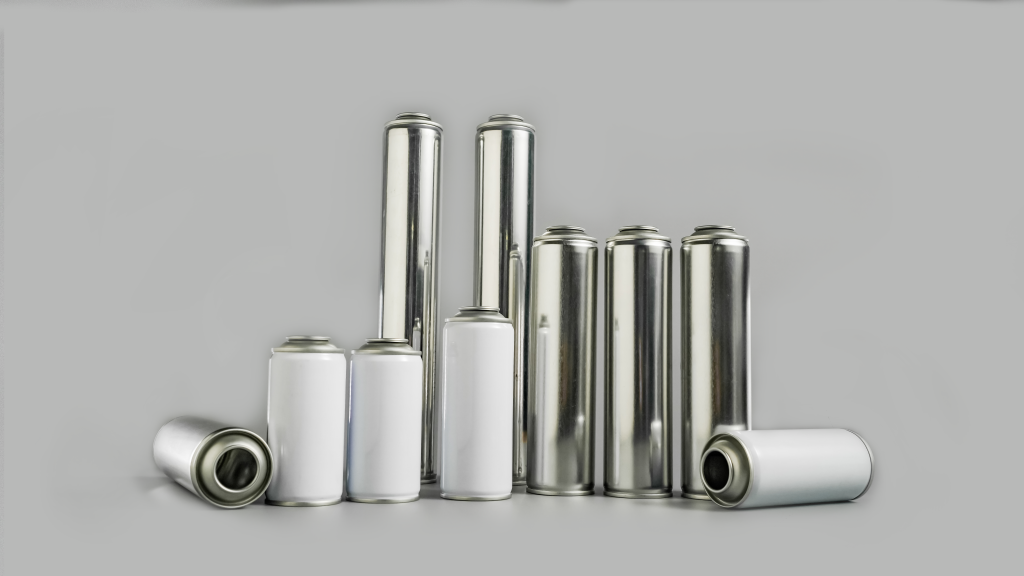
Batch structural damage often occurs to tinplate aerosol can after long-distance container transportation. A recent deodorant can shipment suffered severe bottom bulging and body denting on straight-wall cans, resulting in full-batch rejection.
The aerosol industry universally pursues lightweight production and tinplate material savings. However, simple wall thinning always compromises transportation pressure resistance.
This creates a common dilemma for aerosol designers and manufacturers: balancing lightweight cost control and structural reliability.
Real transportation conditions are far harsher than laboratory static tests. Superimposed stacking pressure and high-temperature internal pressurization easily trigger lightweight tinplate can dome reversal.
Most teams strengthen cans by thickening materials while ignoring structural geometry. Surprisingly, identical designs and materials deliver 30% higher pressure resistance merely via necked-in modification, thanks to superior aerosol can body geometry pressure resistance.
Straight-Wall Can Structural Defects Overview
- Poor mid-section bending resistance: Uniform body diameter without reinforcing structures leads to easy denting under stacking load.
- Weak load dispersion capacity: Gentle neck-body transition fails to divert vertical impact force, causing concentrated overloading.
- High dome reversal risk: Internal pressure impacts the can bottom directly with no buffer structure, raising deformation and scrap rates.
The necked-in structure rebuilds the force-bearing mechanism, driving significant improvement in necked-in aerosol can stacking strength.
The inward-contracted annular neck acts as an integrated rigid reinforcement ring to disperse vertical pressure evenly.
Optimized arch radian transfers internal pressure to the rigid dome base, fundamentally eliminating bottom bulging failures.
Based on 2026 full-condition test data, we conducted comparative tests on two mainstream tinplate thicknesses under normal temperature stacking and high-temperature transportation scenarios.
| Test Condition | Can Type | Tinplate Thickness | Safe Stacking Height | High-Temp Pressure Resistance | Permanent Deformation Rate | Bottom Bulging Failure Rate |
|---|---|---|---|---|---|---|
| Normal Temp Stacking | Straight-Wall Can | 0.22mm | 2.5m | Baseline | Standard Upper Limit | 12.6% |
| Normal Temp Stacking | Necked-In Can | 0.22mm | 3.2m | 30% Above Baseline | 35% Lower | 2.1% |
| High-Temp Transportation | Straight-Wall Can | 0.19mm | 1.8m | 82% of Baseline | Exceeds Standard Limit | 27.3% |
| High-Temp Transportation | Necked-In Can | 0.19mm | 2.7m | 28% Above Baseline | 41% Lower | 3.5% |
Key Conclusion: Under harsh working conditions of 0.19mm thin wall and high-temperature transportation, the bottom bulging failure rate of necked-in cans is only 3.5%, while straight-wall cans reach 27.3%. The structural safety of necked-in cans is 7.8 times that of straight-wall cans.
The strength improvement of necked-in cans comes from both structural optimization and work hardening technology.
Radial stretching rearranges internal metal grains, densifying and hardening the can neck area significantly.
This enables reliable tinplate can wall thickness optimization, balancing lightweight design and structural strength perfectly.
We once undertook a high-pressure insecticide aerosol can project with fixed high-pressure formula and lightweight requirements.
Initial 0.19mm straight-wall cans only achieved a 70% burst test pass rate, failing mass production standards.
By upgrading the high pressure aerosol can structural design to necked-in structure, the pass rate rose to 99.8%.
We adopted precise necking matching and online eddy current flaw detection to eliminate micro-crack risks.
The final solution reduced single can weight by 6g, saved massive tinplate materials annually, and controlled transportation damage rate below 0.01%.
Aerosol Can Selection Guidelines
- Daily chemical aerosols with mild internal pressure: Standard necked-in structure for balanced lightweight performance and stacking safety.
- High-pressure industrial and insecticide sprays: Precision necking combined with wall thickness optimization for enhanced pressure resistance.
- Cans for large-particle contents: Deep necking is not recommended to avoid mouth scratching and sealing risks.
- Long-term stored and transported cans: Necked-in structure resists internal pressure fluctuation caused by temperature differences.
Frequently Asked Questions (FAQ)
tinplate aerosol tin canQ1: Will necked-in design reduce the capacity of ?
The structural adjustment brings negligible volume change. We raise the can shoulder to maintain standard valve caliber and offset spatial changes. For strict capacity requirements, minor body height adjustment achieves full volume matching.
Q2: Are all aerosol cans suitable for necking processing?
Not universally applicable. Cans with ultra-low internal pressure or large-particle filling are not suitable for deep necking. For most standard propellant aerosol cans, necking is the best choice to improve stability.
Q3: Does the necked area become a weak leakage point?
This is a common industry misunderstanding. Necking is integral stretching molding without extra joints. The work-hardened area features higher density and better sealing performance, fully complying with US Department of Transportation DOT 2P/2Q standards for can integrity.
necked-in aerosol can stacking strengthQ4: Can remain stable in complex transportation?
Temperature cycle and continuous stacking tests prove ultra-low strength attenuation. Necked-in cans show far higher structural stability than straight-wall cans under high-temperature, high-humidity and long-haul transportation conditions.
Q5: How to detect hidden structural damage of necked-in cans after sea transportation?
Sea transportation vibration and stacking pressure may cause invisible micro-deformation. Professional aerosol can buckle resistance test is required for hidden damage detection. Equipped with full sets of professional testing equipment, SAILON accurately screens micro-deformation and metal fatigue to ensure batch product safety.
With years of customized tinplate aerosol tin can manufacturing experience, SAILON believes material thinning alone cannot achieve optimal lightweight upgrading.
Structural optimization combined with precision craftsmanship is the core of balancing cost, material consumption and transportation safety.
We are equipped with full-spec necking molds, pressure cycle test benches and professional aerosol can buckle resistance test systems to customize exclusive tinplate can wall thickness optimization and high pressure aerosol can structural design solutions.
We provide full-process support from structural simulation, sample production and full-condition testing to mass production.
Refer to our Tinplate Can Salt Spray Test and Anti-Corrosion Solution for marine transportation protection details, or contact our engineers to obtain a free strength simulation report for high-pressure formula cans.