

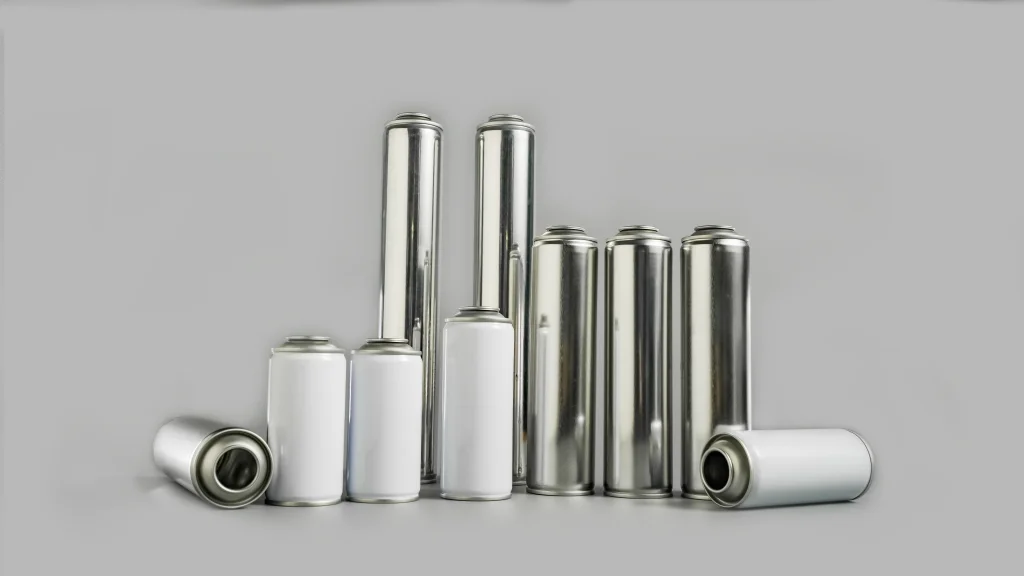
Packaging manufacturers face a common hidden shipping issue. Qualified tin aerosol cans leave factories in perfect condition but develop bulges, bottom deformation and minor leakage after long container transit. These defects skip factory quality checks but appear steadily in hot enclosed environments. Container temperatures can hit 70℃ under intense heat, and vaporizing internal propellants build extreme pressure to deform cans.
Most teams blame weak tinplate material for can deformation, but professional testing disproves this idea. Tinplate features ultra-low thermal expansion and never deforms independently under high heat. Rising saturated vapor pressure from heated contents and propellants acts as the real cause of tin aerosol can bulging. Permanent deformation occurs once internal pressure exceeds the can’s fixed deformation pressure. Continuous pressure growth approaching the burst pressure causes leakage and cracking failures.
Single protection methods cannot solve high-temperature shipping defects fundamentally. Stable results require coordinated upgrades in production craftsmanship, filling parameters, can material specs and shipping arrangements. With years of custom tin aerosol can manufacturing experience, SAILON completes thousands of high-temperature simulation tests. The comparison table below helps engineering and procurement teams identify key performance differences clearly.
| Testing Parameter | Standard Tin Aerosol Can | High-Temperature Resistant Tin Aerosol Can | Optimization Value |
|---|---|---|---|
| Max Saturated Vapor Pressure (50℃) | ≤0.65MPa | ≤0.55MPa | Avoid deformation pressure threshold contact under high heat |
| Filling Headspace Volume Ratio | 6%-8% | 10%-15% | Reserve buffer space to control internal pressure spikes |
| Tinplate Hardness Grade | T2, T3 Regular Sheet | T4 Thickened High-Hardness Sheet | Boost overall anti-deformation and pressure resistance |
| Can Bottom Structure | Flat Basic Design | Arc Anti-Pressure Convex Design | Disperse high internal pressure and prevent bottom bulging |
| Pre-Shipment Inspection | Basic Tightness Test | 55℃ Water Bath Internal Pressure Test + Full Tightness Check | Simulate hot shipping environments and eliminate hidden risks |
Filling headspace control stands as the most overlooked production detail. Many factories reduce reserved internal space to raise filling output. Insufficient headspace volume leaves no room for vaporized propellants, and sudden pressure surges squeeze can walls directly. Industry test data proves over 80% of transit bulging cases stem from unqualified headspace settings.
Stable propellant formula matching controls internal pressure from the source. Mixing ratios of propane, butane and dimethyl ether directly shape saturated vapor pressure levels under heat. SAILON engineers adjust formula proportions based on specific filling materials. This precise control keeps high-temperature internal pressure within safe limits and reduces tin aerosol can bulging risks effectively.
We summarize a practical can upgrade checklist for long-term hot enclosed shipping scenarios:
- Adopt T4 thickened high-hardness tinplate to raise pressure resistance thresholds
- Upgrade to arc convex bottom structures for optimized high-pressure force distribution
- Strengthen weld edge sealing to block leakage under high internal pressure
- Run 4-hour constant 55℃ water bath tests and record complete internal pressure test data
- Thicken can shoulder plates on demand to eliminate local high-temperature bulging
Container loading methods directly impact final product intactness. Deck-exposed containers absorb direct sunlight and heat faster, which increases can pressure loads sharply. Teams can choose under-deck shaded positions and apply container thermal liners. Long-cycle shipments adopt constant-temperature equipment to reduce high-temperature damage to tin aerosol cans.

FAQ
Q1: How to test and predict tin aerosol can bulging risks in high-temperature shipping?
A1: The 55℃ constant-temperature water bath simulation test delivers the most accurate results. Technicians submerge finished cans in thermostatted water for over four hours. They observe deformation and leakage in real time and complete professional internal pressure test recordings. This method perfectly replicates hot container conditions and filters defective products before delivery.
Q2: Can standard tin aerosol cans handle long hot shipping with thermal insulation only?
A2: Standard cans cannot maintain long-term shipping safety. Their material hardness, structural design and pressure specs fit room-temperature storage only, with no optimization for 70℃ extreme heat. Insulation slows heat absorption but cannot stop latent deformation from prolonged pressure. Custom high-temperature resistant cans serve bulk long-distance shipping better.
headspace volumeQ3: Do different can sizes require adjusted standards?
A3: Adjustable settings fit different tank volumes. Small cans maintain a 12%-15% headspace ratio, while large cans adopt a 10%-12% range. Targeted headspace matching adapts to unique vaporization rules and stabilizes shipping safety.
SAILON delivers professional custom tin aerosol can solutions for all high-temperature shipping scenarios. We tailor can craftsmanship and production plans based on client material formulas, shipping cycles and storage environments. Our factory eliminates bulging, leakage and deformation problems fundamentally and guarantees stable quality for bulk shipments.