

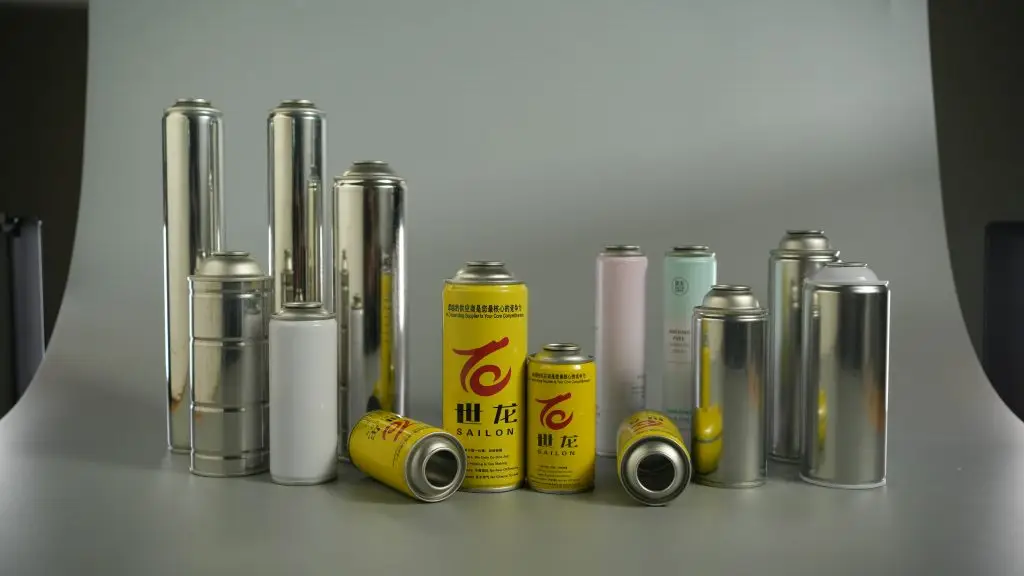
In the mass production and global supply chain of two-component (2K) aerosol coatings, the structural sealing precision of necked-in tinplate aerosol cans dictates the failure rate of premature curing caused by internal piston micro-leakage.
Many high-performance automotive refinish paint and high-solid industrial primer manufacturers suffer from chronic invisible losses: unopened and unactivated products gradually gel, clump, or completely harden within standard warehousing cycles. These failures are rarely caused by defects in the paint formulation itself. Instead, the vast majority are chain reactions triggered by micron-level leakage in the aerosol can’s bottom puncture-sealing system.
A critical detail often overlooked by production managers is that the curing reaction of 2K coatings does not occur exclusively after manual puncture activation. If microscopic gaps invisible to the naked eye exist in the bottom piston seal, atmospheric moisture and oxygen will continuously penetrate the can. This slowly triggers the cross-linking reaction between the hardener (such as isocyanates) and the resin.
Particularly in warehousing environments with fluctuating temperatures and high humidity—such as during transoceanic shipping—this micro-leakage accelerates exponentially. A 2K aerosol paint originally designed for a 12-month shelf life can completely fail within just 3 to 6 months, leading to severe batch scrap costs and warranty disputes for B2B buyers.
1. Failure Mechanism of Premature Curing: The Path of Micron-Level Leakage
2K aerosol paints utilize a dual-chamber system where the base paint and the hardener are stored separately. They rely on a dedicated puncture piston structure at the bottom to achieve instant mixing right before application. The core value of this architecture lies in absolute isolation and sealing during long-term storage. Standard aerosol cans simply lack the machining tolerances and sealing configurations required to store highly reactive 2K coatings safely.
From a manufacturing and materials science perspective, most product failures stem from differential thermal deformation:
- Thermal Expansion Variance: Conventional straight aerosol cans typically utilize generic plastic pistons. The thermal expansion coefficients of the tinplate substrate and the plastic seal differ significantly. Under shifting seasonal temperatures or day-night fluctuations during sea freight, the can body and the piston undergo micro-displacements. Over time, this forms stable micro-capillary channels for leakage.
- Moisture Ingress & Chemical Imbalance: For high-viscosity, high-solid automotive primers, even trace moisture ingress rapidly disrupts the swelling equilibrium between solvents and resins. This initiates localized premature curing, which eventually propagates until the entire can hardens.
- Secondary Valve Failures: If the can body and valve orifice configurations are mismatched, it triggers aerosol “spitting” and uneven discharge during application. This results in overspray, rough textures, or intermittent spraying, severely compromising the final coating quality and your brand’s market reputation.
2. Straight Cans vs. Customized Necked-in Tinplate Cans: Parameter Comparison
To eradicate premature curing and poor atomization at the source, structural engineering, sealing components, and atomization parameters must be optimized upfront. The table below outlines the performance differences based on real-world testing data for 2K dual-component coatings:
| Can Type & Configuration | Internal Pressure at 20°C | Compatible Solid Content (NV) | Sealing & Leakage Resistance (Thermal Cycle Leak Rate) | Atomization & Spray Performance | Shelf-Life Stability (Standard Storage) |
| Standard Straight Can + Single-Orifice Valve | 0.55 MPa | <35% Low-viscosity coatings | High risk of micro-leakage under shifting temperatures; 6-month failure rate reaches 78%. | High-solid coatings clog easily; spitting and overspray rate exceeds 85%. | Gelling and hardening occur within 3–6 months. |
| Standard Straight Can + Dual-Orifice Modified Valve | 0.62 MPa | 35%–45% Medium-viscosity coatings | Stable under constant room temperature; prone to invisible micro-leakage under thermal cycles. | Relatively uniform atomization; minor overspray defects at the spray pattern edges. | Stable for approximately 8 months; highly vulnerable to extreme climates. |
| SAILON Necked-in Tinplate Can + Custom Actuator/Valve | 0.68 MPa (Constant Stabilization) | >50% High-solid coatings | Dual FKM (Fluorocarbon) seals; verified micron-level zero-leakage across all temperature ranges. | Engineered anti-spitting solution; ultra-fine and uniform atomization without clogging or overspray. | 12–18 months of long-term stability without premature curing or gelling. |
3. SAILON Necked-In Tinplate Cans: Customization Advantages for 2K Coatings
Specifically engineered for the storage bottlenecks and performance demands of two-component coatings, SAILON has upgraded four critical dimensions of aerosol manufacturing:
- High-Precision One-Piece Cold Forging Necking: By abandoning the assembly tolerances of traditional straight cans, we precisely control the radial interference fit tolerance between the can mouth and the piston. This eliminates any micro-gaps caused by thermal deformation, ensuring absolute seal integrity prior to puncture activation.
- Dual FKM (Viton) Sealing Components: Equipped with dual-layer, high-temperature, and solvent-resistant fluorocarbon (FKM) O-rings. These are chemically modified to resist the aggressive penetration of 2K hardeners, preventing seal swelling, aging, and deformation to cut off capillary leakage channels entirely.
- Anodic Electrophoresis Anti-Corrosion Internal Coating: Unlike standard spray-applied liners, the entire can interior undergoes an advanced anodic electrophoresis process. This guarantees an ultra-uniform, pinhole-free barrier coating that shields the tinplate substrate from highly active resins, preventing chemical reactions that cause product degradation.
- Fluid Dynamics-Based Valve Orifice Calibration: The valve orifice and auxiliary channels are precisely calibrated according to the client’s exact coating viscosity and solid-to-solvent ratios. This matches the shear-thinning characteristics of high-solid primers, eliminating atomization failures, sputtering, and intermittent discharge.
4. 2K Aerosol Can Selection & Troubleshooting
Q1: When 2K coatings harden during storage, how can we quickly determine if it is a paint formulation issue or a can sealing micro-leakage?
A: This can be verified via a simple inverted control test. Take the same batch of paint and fill both standard cans and SAILON customized necked-in tinplate cans. Store them inverted under identical temperature and humidity conditions for 90 days. If the paint in the standard cans hardens while the necked-in cans remain pristine, it is a definitive case of premature curing caused by piston micro-leakage. In this scenario, you should optimize the packaging structure rather than modifying the chemical formulation.
Q2: Why must high-solid 2K primers use necked-in cans instead of standard straight aerosol cans?
A: High-solid primers feature high resin content and high viscosity, demanding exceptional internal pressure stability and sealing precision. The looser tolerances of straight cans fail to block micron-level moisture over extended periods. Necked-in cans provide superior structural rigidity and tighter mechanical tolerances. When paired with customized valves, they represent the optimal packaging standard to prevent product degradation and application defects in high-solid 2K applications.
Q3: How can we rapidly test 2K aerosol can seal reliability before shipping to mitigate global supply chain risks?
A: We recommend utilizing a Thermal Cycle Test. Place the finished cans in an inverted position and subject them to alternating temperature cycles ranging from -10°C to 45°C over 72 hours. Afterward, use precision pressure gauges and viscometers to verify internal pressure stability and coating fluidity. Cans that pass without pressure drops or gelling are fully qualified to withstand 12+ months of transoceanic shipping and long-term warehousing.
Q4: Can fine-tuning the valve orifice diameter completely resolve aerosol “spitting” problems?
A: Modifying the orifice diameter alone will not completely resolve the issue. Spitting is a complex byproduct of coating viscosity, propellant pressure, and internal valve architecture. Eradicating intermittent discharge and overspray requires a three-in-one calibration that synchronizes the main/auxiliary valve orifices, propellant ratios, and the stable internal pressure of the necked-in can.
5. Conclusion: Designing 2K Aerosol Cans for the Global Market
For B2B two-component aerosol paint manufacturers, product stability depends just as much on the engineering compatibility of the packaging container and sealing system as it does on the chemical formulation.
By implementing high-precision tinplate necked-in cans equipped with chemically modified seals and customized atomization parameters, manufacturers can eliminate both hidden micro-leakage curing and poor spray performance. SAILON provides comprehensive, one-stop aerosol can customization solutions for global automotive refinish, high-performance industrial coating, and premium topcoat brands. From structural engineering and manufacturing upgrades to fluid parameter tuning, we safeguard your product quality from the factory floor to the end user’s hands.