

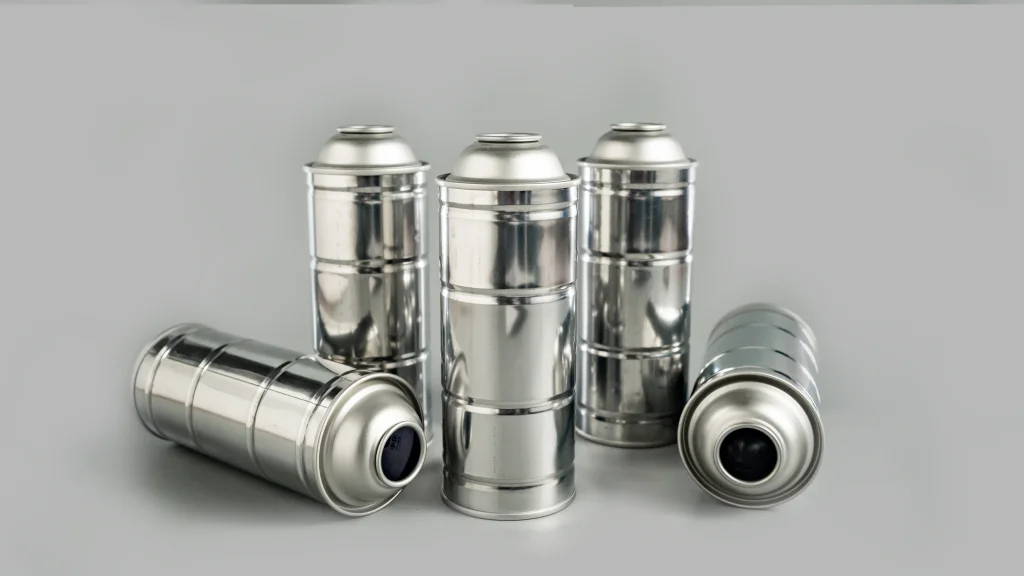
Every aerosol contract filler and brand owner knows that stomach-dropping feeling. Your production run of tinplate aerosol cans looks flawless at room temp, and the double seams pass visual inspection with flying colors. But the moment they hit the mandatory 55°C water bath test, reality strikes. The bottoms of those aerosol cans start to dome, buckle, or permanently deform.
A failed water bath test isn’t just a minor hiccup—它 means your entire batch is dead in the water, blocking compliance and delaying critical shipments. Driven by industry benchmarks like ISO 13088 and GB/T 14449, SAILON leverages 17 years of specialized aerosol can manufacturing to break down exactly why butane cans buckle under pressure—and how our custom-engineered shrapnel-bottom solutions keep your supply chain moving.
Why 55°C is the Ultimate Make-or-Break Temperature for Butane Cans
A common question procurement managers ask is: “Our warehouses and shipping lanes rarely hit 131°F (55°C), so why is this standard so rigid?” This threshold isn’t arbitrary. It is a calculated, worst-case stress test designed to simulate a parked shipping container in mid-July or a hot warehouse under the sun. It forces high-pressure tinplate aerosol cans to prove their structural integrity.
Butane is highly temperature-sensitive. As a liquefied propellant, its internal vapor pressure doesn’t just rise linearly with temperature—it spikes exponentially.
- The Pressure Spike: For every 10°C (18°F) increase in ambient temperature, the vapor pressure of butane jumps by over 30%.
- Yield Strength Limit: At 55°C, the violent molecular expansion inside the can pushes the internal pressure dangerously close to the yield point of standard commercial tinplate.
Without built-in pressure distribution or expansion relief, that raw force strikes the weakest link: the bottom dome. The result? A visibly distorted, “bloated” can that fails safety audits and risks micro-leakage.
Flat Bottom vs. Anti-Buckle Dimpled Bottom: The Engineering Divide
When custom-made butane aerosol cans fail, buyers often blame the wall thickness. However, the real culprit is almost always the hidden geometry of the bottom end.
Standard Flat or Shallow-Dome Ends (The Cost-Cutting Trap)
Many off-the-shelf 65mm butane cans on the market utilize a .028mm thin flat or low-profile bottom end. While economical and perfectly fine for low-pressure room-temperature applications, they lack the geometry to disperse high-stress loads. Once internal pressure crosses the $1.0\ \text{MPa}$ threshold, the force concentrates dead-center, triggering permanent plastic deformation.
SAILON’s Pressure-Relief Dimpled End (The High-Spec Fix)
To eliminate this structural vulnerability, SAILON re-engineered the bottom architecture for high-pressure applications. We utilize a thickened 0.32mm premium tinplate end combined with a proprietary anti-buckle dimpled profile. This geometric design alters the path of internal stress, converting a concentrated localized force into an evenly distributed radial load. It allows a controlled, microscopic flex that absorbs the pressure spike without compromising the seam or changing the can’s footprint.
Performance Comparison: Standard 65mm Diameter Butane Cans
To help quality control and sourcing teams spot the difference before placing a bulk order, here is how our engineered ends stack up under identical 55°C water bath conditions:
| Bottom End Engineering | Material Thickness | Critical Deformation Pressure | Ultimate Burst Pressure | 55°C Water Bath Test Performance | Ideal Applications |
| Standard Flat/Low Dome | 0.28mm | ≤ 1.0MPa | 1.2MPa | High risk of bottom buckling, permanent doming, and micro-leaks. | Low-pressure fills, climate-controlled indoor use. |
| SAILON Anti-Buckle Dimpled End | 0.32mm | ≤ 1.4MPa | 1.7MPa | Zero distortion. Zero leakage. Maintains structural and pressure integrity. | High-pressure butane fills, cross-border shipping, harsh warehousing. |
Bulletproof Batch Control: How SAILON Eliminates High-Temp Failures
A superior blueprint is only half the battle. Delivering millions of cans without a single field failure requires rigorous, repeatable batch control. Our 3-piece tinplate can manufacturing process relies on a strict 4-point quality checklist:
- Volumetric Precision Fills: Overfilling compresses the critical gas headspace. When exposed to heat, an overfilled can experiences an immediate, catastrophic pressure spike. We audit filling parameters to ensure a safe liquid-to-gas ratio.
- Double-Seam Destructive Testing: We routinely section and analyze the top and bottom double seams of production samples, checking optical tightness and overlap to prevent stress concentration from faulty seaming.
- Chemical Compatibility Liners: Depending on your butane purity or gas blend, we apply specialized interior coatings (like epoxy-phenolic) to protect the tinplate from long-term chemical degradation that could compromise metal strength.
- Continuous Hot-Water Testing: We don’t just test at setup. Random batch samples undergo prolonged immersion in 55°C testing tanks to simulate extended real-world thermal stress before any batch gets cleared for delivery.
Technical FAQ for Aerosol Sourcing Managers
Q1: Will a 55°C water bath test failure reject my entire shipment?
Yes. In the aerosol packaging industry, the hot water bath test is a pass/fail safety gatekeeper. Cans that dome or leak cannot legally be transported via standard freight networks and will be rejected by compliance auditors.
Q2: Can we fix the bulging issue just by ordering thicker tinplate?
Not quite. Simply thickening the metal acts as a costly band-aid; it increases rigidity but doesn’t fix poor stress distribution. True reliability requires the dual approach of thickened premium material combined with a pressure-relief dimpled geometry.
Q3: Do you offer custom pressure ratings for harsh export environments?
Absolutely. SAILON specializes in custom tinplate aerosol cans. Whether your product is crossing the equator in ocean freight or requires a specific burst-pressure rating, our engineering team can adjust metal temper, thickness, and bottom profiles to match your precise specs.
Looking for bulletproof aerosol packaging?
Don’t let compliance issues stall your next product launch. Click [Contact Us] to request free samples or get a tailored engineering assessment for your butane filling lines today!