

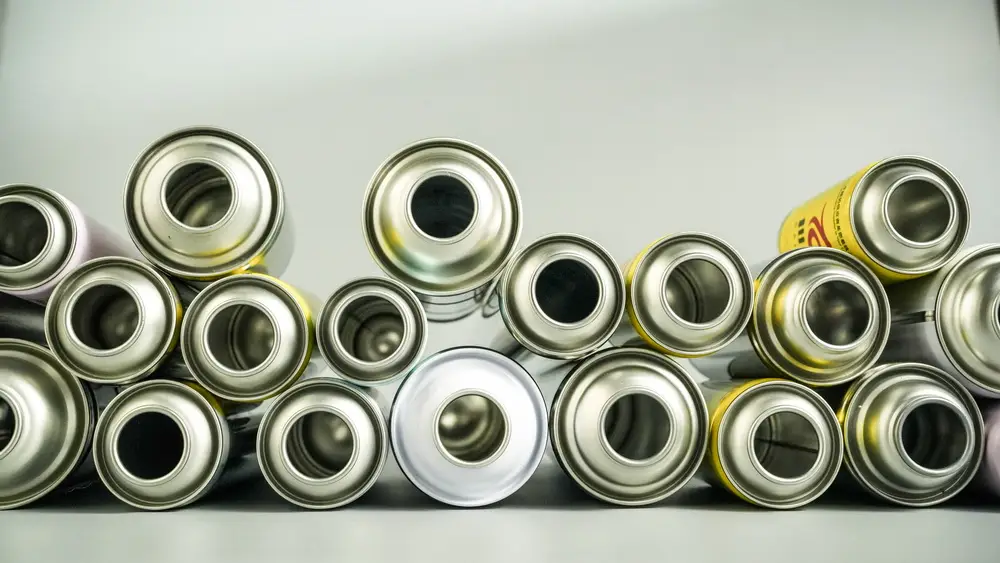
When specifying packaging for household aerosol products such as insecticides, air fresheners, and kitchen degreasers, sourcing procurement leads and R&D managers face a pivotal decision: Three-piece tinplate aerosol cans or monobloc aluminum cans? Making the wrong selection can inflate packaging costs by over 30% or trigger severe quality risks like seam rusting, container deformation, or batch recalls. This actionable B2B guide breaks down the core differences across Cost, Pressure Resistance, and Printing Precision, complete with a B2B decision framework and sourcing pitfall warnings.
1. Tinplate vs. Aluminum: 3D Comparison Matrix
| Comparison Dimension | Three-Piece Tinplate Household Aerosol Can | Monobloc Aluminum Aerosol Can | B2B Procurement & R&D Recommendation |
| 1. Total Procurement Cost | Significantly Lower (Lower raw material cost, ultra-high-speed automated production; 30%–50% overall cost savings) | Higher (High aluminum ingot prices, energy-intensive cold extrusion, higher machinery investment) | Specify Tinplate for high-volume (>100k units), cost-sensitive household products seeking max ROI. |
| 2. Pressure Resistance & Deformation | High Yield Strength (Steel substrate provides superior resistance against internal overpressure deformation) | Prone to Expansion (Softer metal requires thicker wall specification to prevent bottom doming or bulging under pressure) | Specify Tinplate for high internal pressure formulations (e.g., LPG/DME propellants) for safety and economy. |
| 3. Graphic Printing Precision | Flatbed Offset Printing (Printed on flat steel sheets before forming; exceptional color fidelity and sharp detail) | Curved Dry Offset Printing (Printed on pre-formed cylindrical cans; complex graphics suffer distortion) | Specify Tinplate for intricate artwork, gradients, small instructional text, or anti-counterfeiting elements. |
| 4. Structural Appearance | Visible Longitudinal Seam (Modern high-frequency welding makes the seam virtually invisible) | 100% Seamless Monobloc (Seamless extruded body with smooth contoured aesthetics) | Specify Aluminum if 360° seamless aesthetics or custom contoured shapes are mandatory. |
| 5. Chemical Compatibility | Internal Coating Required (Requires dedicated epoxy/polyester internal lacquer for water-based or corrosive formulas) | Natural Oxide Layer (Inherent oxidation layer, though strong acids/alkalis still need internal lining) | For water-based household formulas, verify internal lining integrity and corrosion testing with the supplier. |
2. B2B Selection Decision Framework & Sourcing Pitfalls
1. Rapid Sourcing Guide
- Step 1: Baseline Criteria
- Is a 360° seamless/custom contoured body or extreme pH formula mandatory?
- YES→ Select 【Monobloc Aluminum Aerosol Can】
- NO → Proceed to Step 2
- Is a 360° seamless/custom contoured body or extreme pH formula mandatory?
- Step 2: Household Product Assessment
- Is it a household chemical product (e.g., insecticide, air freshener, degreaser, cleaner)?
- Select 【Tinplate Household Aerosol Can】 if 2 or more of the following criteria apply:
- Annual volume exceeds 100,000 units
- Margin-conscious / targeting packaging cost optimization
- Artwork requires fine text, intricate gradients, or high-definition graphics
2. Top 3 Sourcing Pitfalls to Avoid
- Pitfall 1: Over-Specifying Aluminum and Ruining Product Margins Brand managers sometimes fall in love with the seamless look of aluminum cans for high-volume household care lines. However, household aerosols are price-sensitive consumer commodities. Aluminum containers can increase unit packaging costs by 30% to 50%, severely eating into your gross margins at scale.
- Pitfall 2: Neglecting Internal Corrosion Compatibility for Water-Based Formulas Modern household aerosols heavily utilize eco-friendly water-based formulations. Because the steel base of tinplate can corrode if exposed to moisture, never skip internal lining verification. Ensure your tinplate supplier provides certified epoxy/polyester internal coatings along with salt-spray and shelf-life stability test reports.
- Pitfall 3: Focusing Solely on Unit Price While Ignoring Pressure Safety Ratings Aerosol cans are pressurized containers governed by strict transportation and safety standards. Low-grade manufacturers may use under-gauge tinplate, leading to container distortion or bottom doming when internal pressure exceeds 1.2 MPa. Always verify supplier compliance with Deformation Pressure and Burst Pressure standards (e.g., DOT-2P/2Q or GB standards).
3. FAQ
Q1: How do modern manufacturers solve seam rusting or leaking in tinplate aerosol cans?
A: Historically, the side seam was a potential weak point. Premier custom manufacturers like SAILON utilize advanced High-Frequency Resistance Welding (WB) technology that produces ultra-narrow weld seams (approx. 0.2mm). Immediately after welding, a liquid or powder Epoxy/Polyester Side Stripe Coating is applied internally and cured at high temperatures, while clear lacquer protects the external seam. This ensures the seam achieves identical anti-corrosion and pressure-sealing performance as the rest of the can body.
Q2: Why does a tinplate household aerosol can offer superior printing resolution compared to aluminum?
A: It comes down to the printing process. Tinplate cans utilize Flatbed Offset Lithography, applying ink while the metal sheet is completely flat. This allows micrometer-level registration accuracy, rich color gradients, crisp small fonts, and sharp vector details. Conversely, aluminum cans undergo Curved Dry Offset Printing on pre-formed round cans, where ink dot gain and curve stretching limit graphic sharpness.
Q3: What key criteria should be audited when choosing a custom tinplate aerosol can manufacturer?
A: Audit your packaging partner based on four essential benchmarks:
- In-Line Leak Testing: 100% automated high-pressure air/water-bath leak detection on the production line;
- Tailored Coating Options: Ability to match internal lacquers to alcohol-based, water-based, or solvent-based formulas;
- Dimensional Range: Comprehensive tooling options (e.g., 45mm, 52mm, 57mm, 65mm diameters);
- Color Management Systems: Spectrophotometer-backed color control ensuring consistency across production runs.
4. Summary
For high-volume household care products, the tinplate household aerosol can remains the undisputed industry standard—delivering an unbeatable balance of cost efficiency, structural pressure resistance, and high-definition lithographic printing.
As a specialized B2B manufacturer of custom tinplate aerosol cans, SAILON empowers aerosol brand owners with dependable, high-performance packaging solutions:
- Premium Raw Materials: High-tensile cold-rolled tinplate ensuring pressure resistance that exceeds safety standards;
- Zero-Defect Seam Technology: Advanced high-frequency wire welding paired with precision side-stripe coating to eliminate leaks and rust;
- High-Definition Printing: Multi-color flatbed lithography that elevates shelf presence and brand visual identity;
- Custom Coating Engineering: Specialized internal lacquer formulations tailored for water-based, solvent, or aggressive chemical fills.
💡 Planning a new household aerosol launch or seeking to optimize existing packaging costs?
Contact the SAILON Packaging Engineering Team today to request your free sample kit, corrosion compatibility evaluation, and custom factory quotation!