

Editor’s note: SAILON makes aerosol tin cans in Foshan, including the 65 mm straight-wall bodies used for contact adhesives in furniture, mattress and automotive-interior plants. We supply the can, not the adhesive — which means when a spray gun spits, we are usually the first party blamed and the second party asked to prove it.
A sofa frame plant running two shifts goes through roughly 300 cans of contact adhesive a week. The complaint that reaches us is almost never “the glue is bad”. It is specific and physical: the gun spits after forty minutes, the operator wipes the nozzle, the pattern goes patchy, the bond fails on a seam, and by the end of the shift somebody is spraying twice as much adhesive to get the same grab.
Every one of those symptoms can be produced by a perfectly good adhesive in a can that was specified for a different product. Spray adhesive is one of the few aerosol categories where the packaging has to be engineered against the chemistry, because the chemistry is unusually hostile: high solids, aggressive solvents, and — in chloroprene systems — a slow release of acid that will find any thin spot in the internal coating and turn it into a pinhole.
In short
Spray adhesive fails at four interfaces: coating to chemistry, valve to viscosity, propellant to solids, can shape to filling line. Your purchase order only usually describes the fourth.
Chloroprene adhesives release hydrogen chloride as they age. A single-pass lacquer at 5 g/m² will hold for months and then pit — usually in a warehouse in a humid climate, not in your plant.
Most “the gun keeps clogging” complaints are a valve orifice and a solids content that were never introduced to each other.
Why adhesive is a harder customer than insecticide or hair spray
Three properties separate a contact adhesive from the products most aerosol cans are designed around.
Solids. A sprayable contact adhesive typically carries 25–45 % solids by weight — polychloroprene or SBS rubber dissolved in a solvent blend of toluene, acetone, ethyl acetate or hexane. That is an order of magnitude more dissolved material than a hair spray, and it changes how the product behaves at every stage: it is viscous, it settles, it skins at the orifice, and it does not want to leave the can at a uniform rate.
Acidity that develops over time. Polychloroprene is made by emulsion polymerisation and carries residual chloride. Over months, especially at elevated temperature, it dehydrochlorinates and releases HCl. Adhesive makers add acid scavengers — magnesium oxide, epoxidised oils — to slow this down, but they are buying time, not eliminating the reaction. The can has to survive the time they bought.
Propellant that dissolves into the product. With DME or a DME-hydrocarbon blend, a meaningful fraction of the propellant goes into solution in the adhesive rather than sitting above it as a vapour blanket. As the can empties, the headspace grows, more propellant leaves the liquid, and the internal pressure falls. This is why the last third of an adhesive can sprays differently from the first third — and why “it worked fine on the sample can” is such a common and misleading finding.
Interface one: the internal coating is the whole game
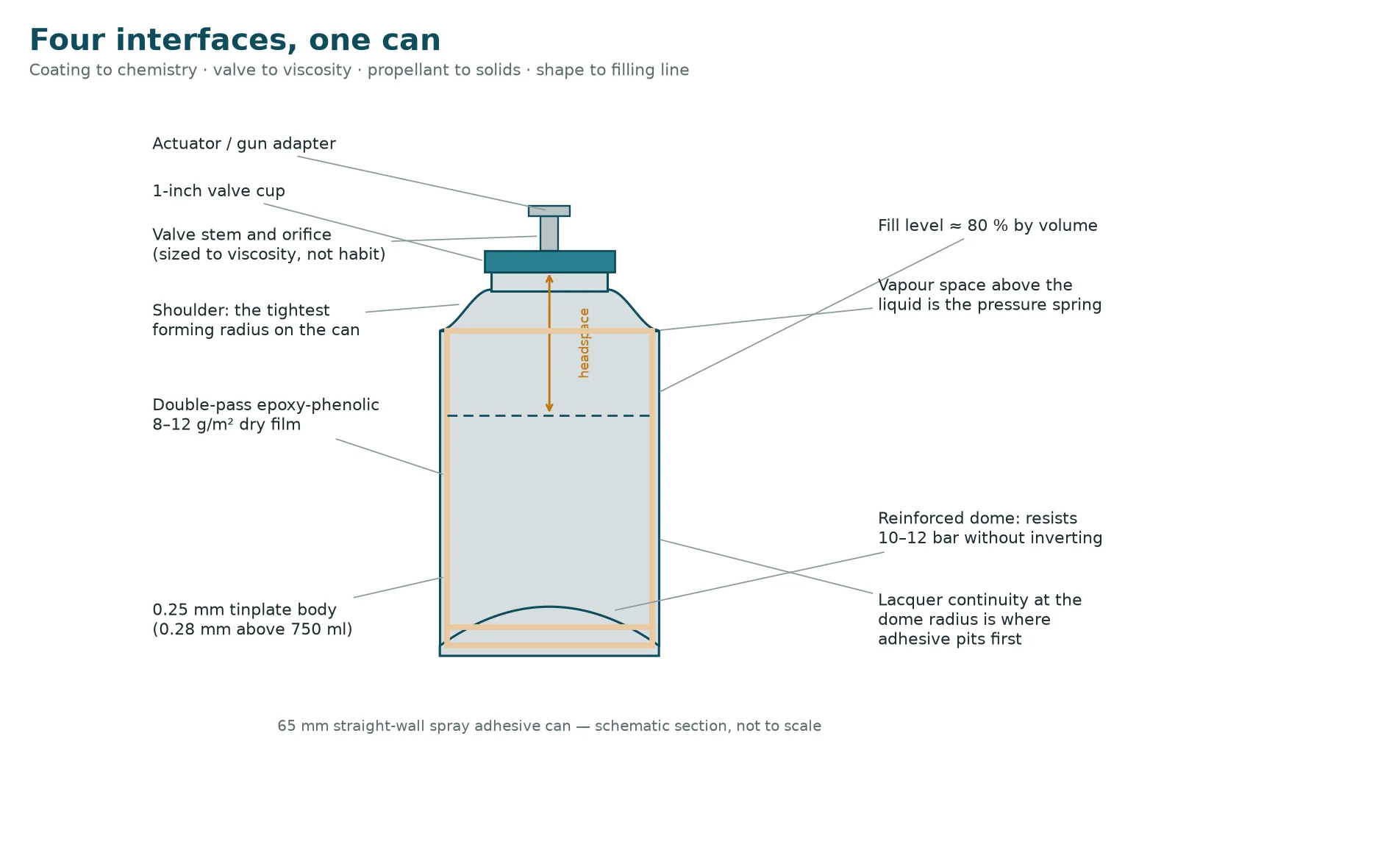
For solvent-borne adhesive we specify a double-pass epoxy-phenolic at 8–12 g/m² dry film, and we check it as a film weight per can, not as a pass/fail on a dipper reading. Single-pass coating at 4–6 g/m² is normal for a low-aggression product and completely routine in this industry; on a chloroprene adhesive it is an 18-month failure waiting for a warm warehouse.
The failure does not look like corrosion at first. It looks like dark specks in the spray pattern — iron sulphide or tin salts lifted from a pitted spot — followed by a pinhole leak at the bottom dome or along the side seam. The mechanism is the same one described in the five packaging pitfalls behind corrosion in solvent-based aerosols, only slower, because adhesive attacks a coating chemically rather than mechanically. By the time the operator reports specks, the can has already been reacting for months.
What we test before a coating goes on an adhesive job
Three tests, and we run all three on every adhesive project regardless of what the buyer asks for.
- 28-day immersion at 50 °C. Filled cans held at 50 °C for four weeks, then cut open. We look for blistering at the dome radius and at the weld, and we measure film adhesion by cross-hatch. A coating that passes at 25 °C and fails at 50 °C is the normal outcome of skipping this test.
- Acid consumption. A strip of coated plate in the actual adhesive, titrated for HCl uptake over time. This tells us whether the adhesive’s scavenger package is sized for a two-year shelf life or a six-month one, and it is the number that decides whether a 10 g/m² film is generous or barely adequate.
- Weld and seam integrity under the same load. The side seam is a welded overlap with its own coating regime; adhesive finds the unprotected edge of that overlap faster than it finds anything else. Our notes on weld leakage describe the erosion pattern.
Interface two: the valve has to be chosen against viscosity, not against habit
A 0.4 mm orifice valve is a sensible default for a low-viscosity product. Put a 35 % solids adhesive through it and you get a narrow, high-velocity jet that atomises badly, builds up a ring of dried adhesive on the nozzle face, and starts spitting within the hour. The fix is not a stronger solvent — it is a bigger orifice and, usually, a different spray geometry. The three metrics that have to be fixed together, rather than one at a time, are set out in our guide to high-pressure can selection and clogging.
| Symptom on the line | What it usually is | Where it should have been locked |
|---|---|---|
| Gun spits after 30–60 minutes; nozzle face crusts | Orifice too small for solids content; adhesive skins in the valve stem between sprays | Valve specification, agreed against the adhesive’s viscosity at 25 °C — not against a catalogue default |
| Pattern goes patchy, coverage drops, operators spray twice | Pressure decay as propellant leaves solution; often paired with an under-filled can | Fill ratio and propellant blend, verified on a 50 °C storage trial |
| Dark specks in the spray, then a pinhole at the dome | Coating breakdown under acid; single-pass film or a thin spot at the dome radius | Internal lacquer weight and a 28-day compatibility test |
| Can collapses when the plant opens a pallet in winter | Filled hot, cooled in transit; internal pressure fell below atmospheric | Filling temperature and headspace agreed with the can’s pressure rating, not guessed |
| Leak at the crimp only on the second pallet | Curl diameter drift across a long run; filling head not re-set | Hourly curl gauge on our line, plus a crimp check on yours |
Two of those five rows are ours to control. Two are shared. One — the coldest, most predictable one — is almost always a conversation nobody had before the first purchase order.
Interface three: propellant, fill ratio and the last third of the can
In a furniture plant the cost of a bad fill ratio does not appear as a leak. It appears as adhesive consumption per unit of output, and it is invisible because the operator compensates by spraying more and nobody measures grammes per frame.
For a 750 ml straight-wall can carrying a DME-hydrocarbon blend, we work with fill ratios around 78–82 % by volume for a 400–450 g net fill, and we size the headspace against the pressure at 50 °C rather than at 20 °C. Push the fill to 85 % to get more product per can and you gain eight per cent of adhesive and lose the pressure margin that keeps the spray pattern stable at the end of the can — the same trade-off that makes 52 mm versus 65 mm a cost decision rather than a cosmetic one. In a plant that stores pallets under a metal roof in summer, that trade is not worth taking.
The test that settles it
Fill twelve cans. Store six at 50 °C for seven days, six at ambient. Then spray all twelve to emptiness, weighing each one every ten seconds, and plot delivery rate against percentage of fill discharged. A good can-and-valve combination gives a flat line to about 85 % discharged and a controlled decline after that. A bad one falls off a cliff at 60 % — which is exactly the “it stops spraying properly when it’s half full” complaint, reproduced on a bench in a week instead of on a shop floor in a quarter.
Interface four: can shape against the filling line you already have
Adhesive is usually filled on equipment the customer already owns, often a pressure filler with a specific valve-cup size and a specific can height range. This is where specification discipline pays: a 65 mm straight-wall can with a 1-inch valve cup and a reinforced bottom is the workhorse for this category, and it is not interchangeable with a 65 mm necked-in can on the same line without a change part.
Three dimensions travel with the order and should be written on it: can height and diameter (they set the filler’s change parts), valve cup size (1-inch is standard here, but confirm), and bottom profile (a reinforced dome for pressure, or a flat-bottomed variant where the filler’s conveyor needs it). If your adhesive supplier and your can supplier have never spoken, this is the paragraph to send to both of them.
What to put on the purchase order
Copy this block into your RFQ. It is the difference between a can that is cheap and a can that works, and none of it is proprietary.
Can
65 mm straight-wall aerosol tin can, 0.25 mm (0.28 mm where fill exceeds 750 ml or the propellant is hydrocarbon-heavy), reinforced bottom dome, plain or printed body, 1-inch valve cup.
Internal coating
Double-pass epoxy-phenolic, 8–12 g/m² dry film, with the film weight stated per can and a 28-day at 50 °C compatibility report supplied with the first lot.
Valve
Orifice sized against the adhesive’s viscosity at 25 °C, spray pattern and flow rate stated numerically, and — for overhead or vertical work — an upside-down valve confirmed in writing.
Fill and pressure
Net fill in grammes, fill ratio by volume, propellant blend, and the maximum storage temperature the can is expected to survive. Ask the supplier to confirm the burst and deformation margins against your numbers, not against a generic standard.
When an aerosol tin can is the wrong answer
Three cases where we tell buyers to walk away, because a failed order costs more than a lost one.
Water-based adhesive. A waterborne system in an aerosol tin can is a corrosion test with a two-month timer, regardless of coating. If the formulation is water-based, the packaging has to be lined differently or made from a different substrate entirely.
Very high daily consumption. A plant using more than roughly 60 cans a day per line is usually better served by bulk adhesive and a pressure pot with a hose. The aerosol can is a convenience and portability product; above a certain volume you are paying for portability you no longer need.
Two-component adhesive. That is a different can — dual-chamber or a paired-cartridge — and it should not be quoted as a variant of a single-component can. If a supplier says yes without asking which component goes where, that is your answer.
FAQs
Why does my adhesive can spray well for a week and then spit?
In that order of likelihood: adhesive skinning at the valve orifice between shifts (clean the nozzle and cap it, and check the orifice size), pressure decay from an under-filled can or a propellant that has fully dissolved, or coating breakdown releasing particles. The first is a habit, the second is a specification, the third is a claim — and they can be told apart by cutting one can open.
Can I use the same can for adhesive and for a solvent-based cleaner?
The body, yes; the coating, sometimes; the valve, rarely. A cleaner needs a fine mist and a small orifice. An adhesive needs a large orifice and a wet, heavy pattern. Sharing a can specification across two products is a common way to save a plate set and lose a filling line’s throughput.
How long can filled adhesive cans sit in a warehouse?
With a double-pass coating and a properly sized acid scavenger, two years is realistic for a chloroprene system stored below 35 °C. Halve it for every 10 °C above that, and halve it again if the coating is single-pass. If your market includes a tropical warehouse with no climate control, specify for that warehouse, not for your own.
Do I need a printed can, or can I label it?
In furniture and mattress plants, printed wins on two counts: the can is handled with adhesive on the operator’s gloves, and a paper label lifts within a shift. Direct offset print on the tinplate has no edge to lift. The realistic limit is the print minimum — short runs of four-colour designs are expensive, which is why many buyers run one printed design per product family and accept a single colour across sizes.
Send us the adhesive, not just the can size
The useful conversation starts with three facts: solids content, solvent system, and daily consumption per line. With those we can tell you which coating weight, orifice and fill ratio will hold, and whether a 65 mm straight-wall can is the right body at all. If it is not, we will say so before you pay for a plate set.
We press and print in the same plant in Foshan — eight high-speed can lines and ten printing lines, 45 mm to 70 mm, from 50,000 pieces — so the coating that goes into your can is decided by the same quality team that measures the film weight.
See the 45–70 mm can and end range, or send your adhesive’s technical data sheet and we will come back with a can specification rather than a price.