

A claim on a shipment of aerosol tin cans almost never arrives as a number. It arrives as a photograph of one can, a pallet count, and a sentence saying the shipment is bad. What it rarely arrives with is a count that both sides can check, which is why so many of them turn into an argument about tone rather than about cans.
Grading is the part that turns an impression into a figure. Not the vocabulary — everyone already uses the words critical, major and minor — but the rules underneath the words: which physical test puts a defect in which tier, how many cans you have to look at before the number means anything, and what each tier is worth when the conversation moves to money.
This is the method we work to when a complaint reaches us, written from the side of the table you will be sitting on. Grading, sampling, tracing the defect back to a process, photographing it so a stranger can verify it, and the arithmetic that decides whether a claim is worth fighting.
What a grade is actually deciding
A grade is not a description of a can. It is a decision about three separate things, and they are easy to confuse:
- whether the can may enter your line at all
- whether you are entitled to keep the money you have already paid
- who pays for the freight that moves the problem somewhere else
Two people can look at the same can and both be technically right, because “critical” is doing different work in each of their heads. The quality manager means this should never have been made. The purchaser means this is going to cost us. The supplier hears we want a credit. None of those is a grade. A grade is a test with an outcome.
The table below is the one worth agreeing in writing before the first container, because it is nearly impossible to agree afterwards.
| Grade | The test that assigns it | What happens to the can | What happens to the money | Common AQL in a PO |
|---|---|---|---|---|
| Critical | It can lose containment or pressure: curl crack, score split, flange crack, false weld, pinhole, a seam that failed the double-seam gauge | Quarantine. Nothing enters the line until it is inspected or rejected | Replacement or sort at the maker’s cost, including freight when the fault is theirs | 0 — zero acceptance in the sample |
| Major | It will run, but it will stop the line or fail the filler’s own gauge: ovality, curl diameter outside the head’s window, a dent at the valve cup seat, seam thickness out of range | Sort before use, or set aside the affected pallets | Credit or replacement of the affected batch | 0.65 – 1.0 |
| Minor | It changes only how the can looks: print drift, shade variation, a scuff on the lacquer, polish marks on the body | Run it | Priced. A credit note per thousand | 2.5 – 4.0 |
Those AQL figures are conventions, not physics. What matters is not which convention you pick but that the purchase order states one, in the same document the supplier signed.
Why “critical” is not the same as “obvious”
The eye ranks defects by visibility. Containment ranks them by consequence. Those two rankings disagree constantly.
A curl crack two tenths of a millimetre long is invisible at arm’s length and will empty a pressurised can into a carton over a few weeks. A forty-millimetre scuff across a printed body is the first thing anyone sees on the pallet and will not affect a single unit of product. The scuff gets photographed. The crack gets shipped.
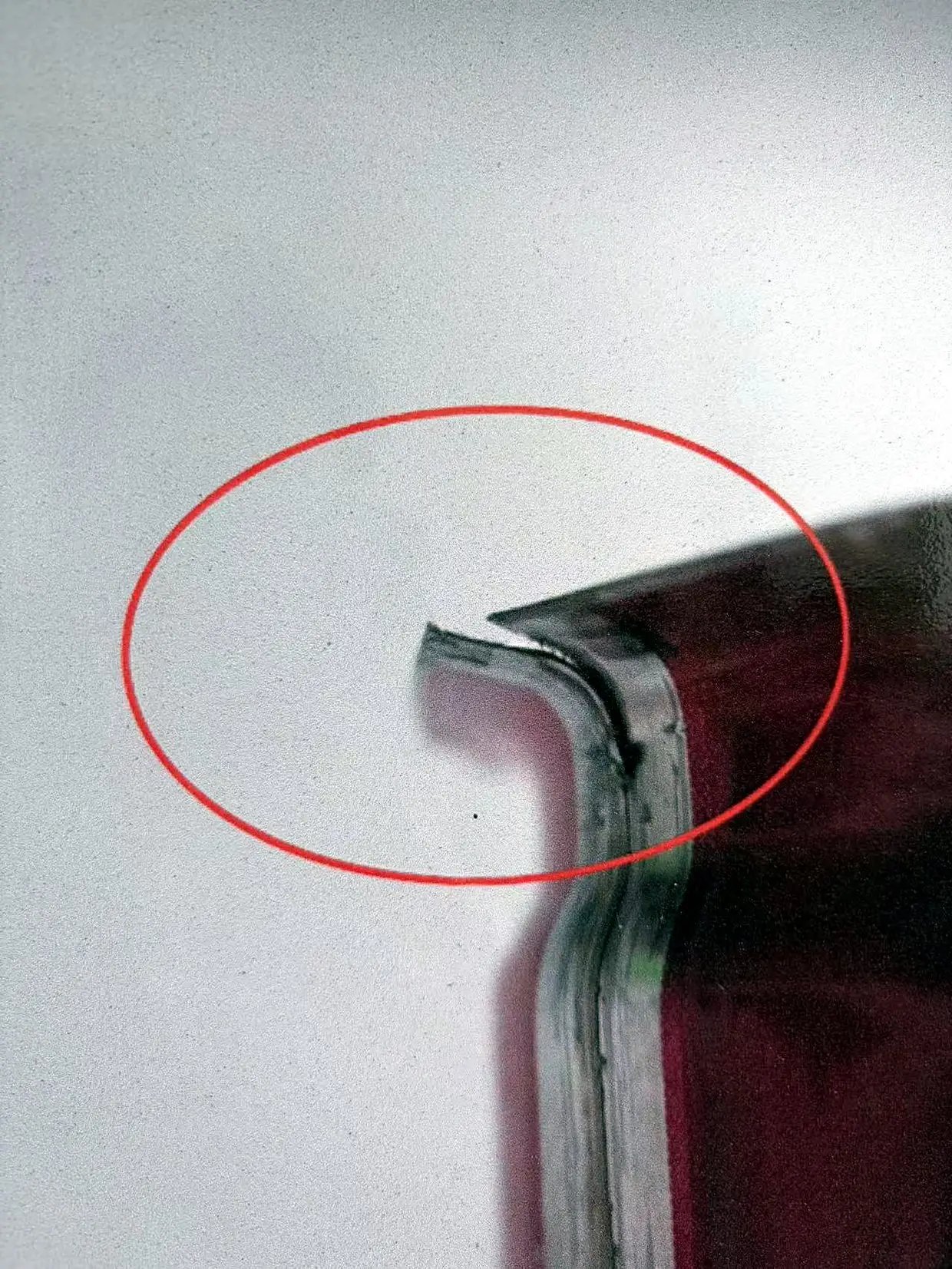
There is a second reason this matters, and it catches experienced buyers out. The same crack changes grade with temperature. Internal pressure in an aerosol tin can rises steeply as it warms — for a butane-rich propellant, roughly doubling between a cool warehouse and the roof of a container in July. A marginal curl crack that holds at 18 °C will weep at 45 °C. So a lot inspected in a mild month can fail in a hot one, and a defect that “passed our inspection” is not the same claim as a defect that is not there.
If your customer stores in a warm climate, inspect at something closer to their temperature, or accept that your incoming inspection has a seasonal blind spot. This is the single most common reason a defect that was nobody’s fault in March becomes everybody’s problem in August.
The three questions, in order
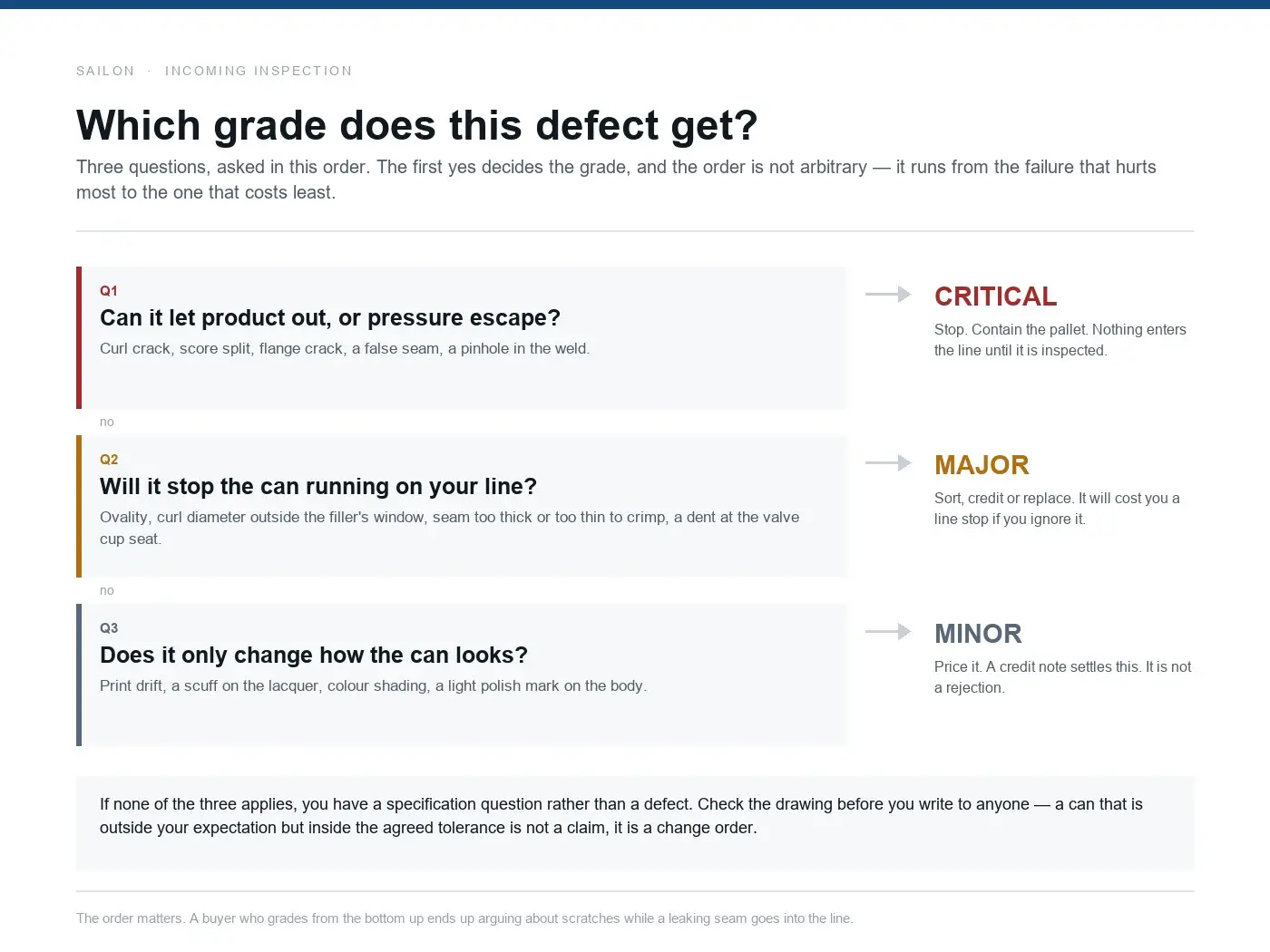
Ask them in this sequence, and stop at the first yes:
- Can it let product out, or pressure escape? If yes, critical — regardless of size, regardless of how few you found, regardless of how good the rest of the pallet looks.
- Will it stop the can running on your line? If yes, major. This is the tier that gets under-counted, because a can that jams a filler head at 2 a.m. causes more damage than one that leaks in a warehouse nobody visits.
- Does it only change how the can looks? Then it is minor, and minor means priced, not rejected.
There is a fourth outcome that people forget to allow for: none of the three apply, and you have a specification question rather than a defect. A can outside your expectation but inside the tolerance you agreed is not a claim. It is a change order, and the sooner it is treated as one the cheaper it is.
What over-grading costs
Grading everything critical feels like the safe position. It is the expensive one, for reasons that are not obvious at the time.
A supplier who receives three “critical” claims that turn out to be cosmetic learns to discount your inspection reports. That discount is invisible until the fourth claim, which is real, and arrives with a paragraph of polite scepticism attached. You have spent your credibility on scratches and now need it for a seam.
There is a shorter-term cost too. A 3% minor rate on one pallet is a credit note and a phone call. Call the same 3% critical and it becomes a rejected container, a return freight bill, and a six-week gap in supply while the replacement crosses an ocean. The cans did not change. The grade did, and the grade decided the cost.
A grade means nothing without a sampling plan
The grade describes one can. The claim is about twenty-four thousand of them. In between sits a sampling plan, and if the plan was never agreed, the argument will be about the plan rather than about the cans — which is a much harder argument to win, because there is nothing to photograph.
What an AQL actually promises
AQL stands for acceptable quality limit, and it is defined in ISO 2859-1 and its American twin ANSI/ASQ Z1.4. Both describe a procedure: draw a stated number of pieces from the lot, count the defects, compare the count against an acceptance number, accept or reject the lot.
Two things follow from that, and both surprise people who have signed a hundred purchase orders without reading the annex.
It is not a quality target. It is a rule for splitting risk between the producer and the consumer. A lot that passes at AQL 1.0 is not a lot with 1% defects.
The number in the contract is not the number in the box. On a 24,000-piece lot the standard sample is 315 cans. At AQL 2.5 the acceptance number is 14 — which means a lot can pass with fourteen defects in a sample of 315, and fourteen out of 315 is 4.4%. Nobody who writes “AQL 2.5” in a contract believes they have agreed to 4.4%.
| Lot size | Sample size (level II) | Accept at AQL 1.0 | Accept at AQL 2.5 | Accept at AQL 4.0 |
|---|---|---|---|---|
| 1,201 – 3,200 | 125 | 3 | 7 | 10 |
| 3,201 – 10,000 | 200 | 5 | 10 | 14 |
| 10,001 – 35,000 | 315 | 7 | 14 | 21 |
| 35,001 – 150,000 | 500 | 10 | 21 | 21 |
Single sampling, normal inspection, general inspection level II. Tightened or reduced inspection changes both the sample size and the acceptance number, so read the plan you actually bought rather than this table.
A worked example, because the arithmetic is the argument
Twenty-four thousand aerosol tin cans arrive. You sample 315 and find seven with a cracked curl.
- Seven out of 315 is 2.2%.
- At AQL 1.0, the acceptance number for a 315 sample is 7. Seven is not more than seven. The lot passes.
- At AQL 0.65, the acceptance number is 5. The lot fails.
Same cans, same photographs, opposite conclusions. The question “is seven cracks a lot?” has no technical answer — it has a contractual one, and the contract was written months before anybody saw a crack.
This is why the tier and the number have to be decided together. If what you actually want is zero cracks, buy zero: write critical defects, zero acceptance in the sample; any occurrence rejects the lot. That is a legitimate and common term. It also has a price, because a supplier who accepts it is accepting the risk of scrapping 24,000 cans over one piece, and will build that risk into the unit price. Know which trade you are making.
Four ways the number gets talked into a yes
None of these are fraud. All of them are normal commercial behaviour, and all of them are worth recognising in a report.
- Reduced inspection. After a run of accepted lots, the standard allows a smaller sample at the same acceptance number. Fewer cans examined, same tolerance for defects.
- Level I instead of level II. A legitimate choice on the form, roughly half the sample, and it will be described as “our standard practice” rather than as a reduction.
- Sampling from the surface. Top cartons and the outer layer of the pallet are the easiest to reach and the least representative. Handling damage is concentrated exactly there.
- Counting the dangerous ones as the cheap ones. A report that lists forty “surface defects” without splitting them by tier has folded a critical finding into a cosmetic total. Ask for the split.
There is a fifth, subtler one: a sample drawn from the last pallets of a run, taken after the operator noticed the problem and corrected it. The cans that carry the defect are the ones already in the middle of the pallet.
What to put in the purchase order
Five lines. They cost nothing to write and they decide most of the arguments that follow.
Finding the station that made the defect
Grading says how bad. Tracing says whose. Without the second, the first is an opinion with a number attached.
Aerosol tin cans collect damage at five distinct stages, and each stage leaves a different kind of evidence. The map below is the one we use internally, because it is also the one that tells us whether to investigate or to argue.
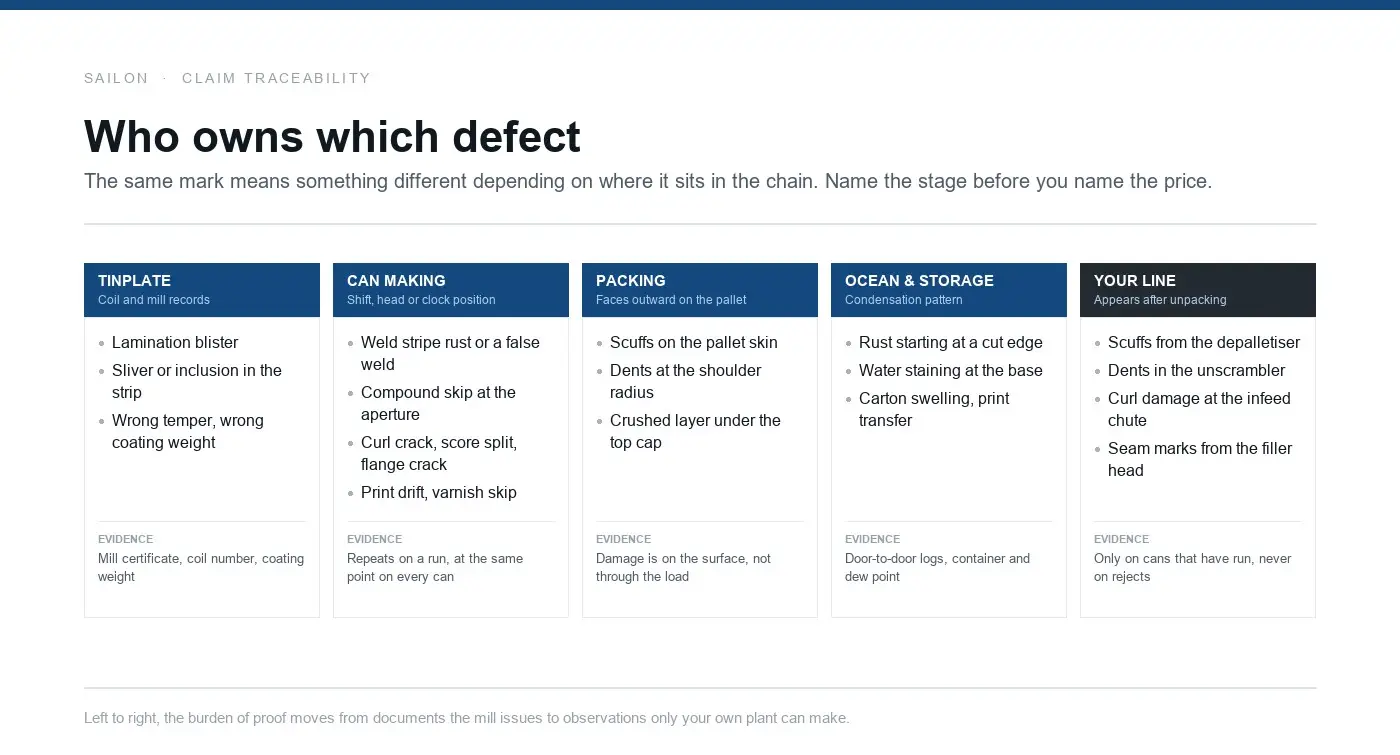
1. Was the pallet intact when it was opened?
This is the branch that decides everything downstream, and it is the one most often destroyed before anyone thinks to record it.
Intact cartons, intact top cap, internal defect: the factory is the likely origin. Crushed corner, torn liner, re-taped carton, deformed top cap: you are looking at a handling or freight event, and the claim belongs to the carrier or the insurer rather than the can maker.
Photograph the pallet and the carton before you cut the straps. Once the load is broken, the one piece of evidence that settles the first question is gone, and the conversation moves to opinion.
2. Does it repeat at a fixed position?
Factory defects repeat with a signature. Handling damage does not.
A compound skip at the aperture that appears at the same clock position on every can in a run is a lining head. The same defect scattered at random angles is contact damage. A band of print drift that runs across the sheet is a plate or a blanket; a single can with drift is nothing. Rust that follows the weld stripe is a weld problem, and the location is the evidence.
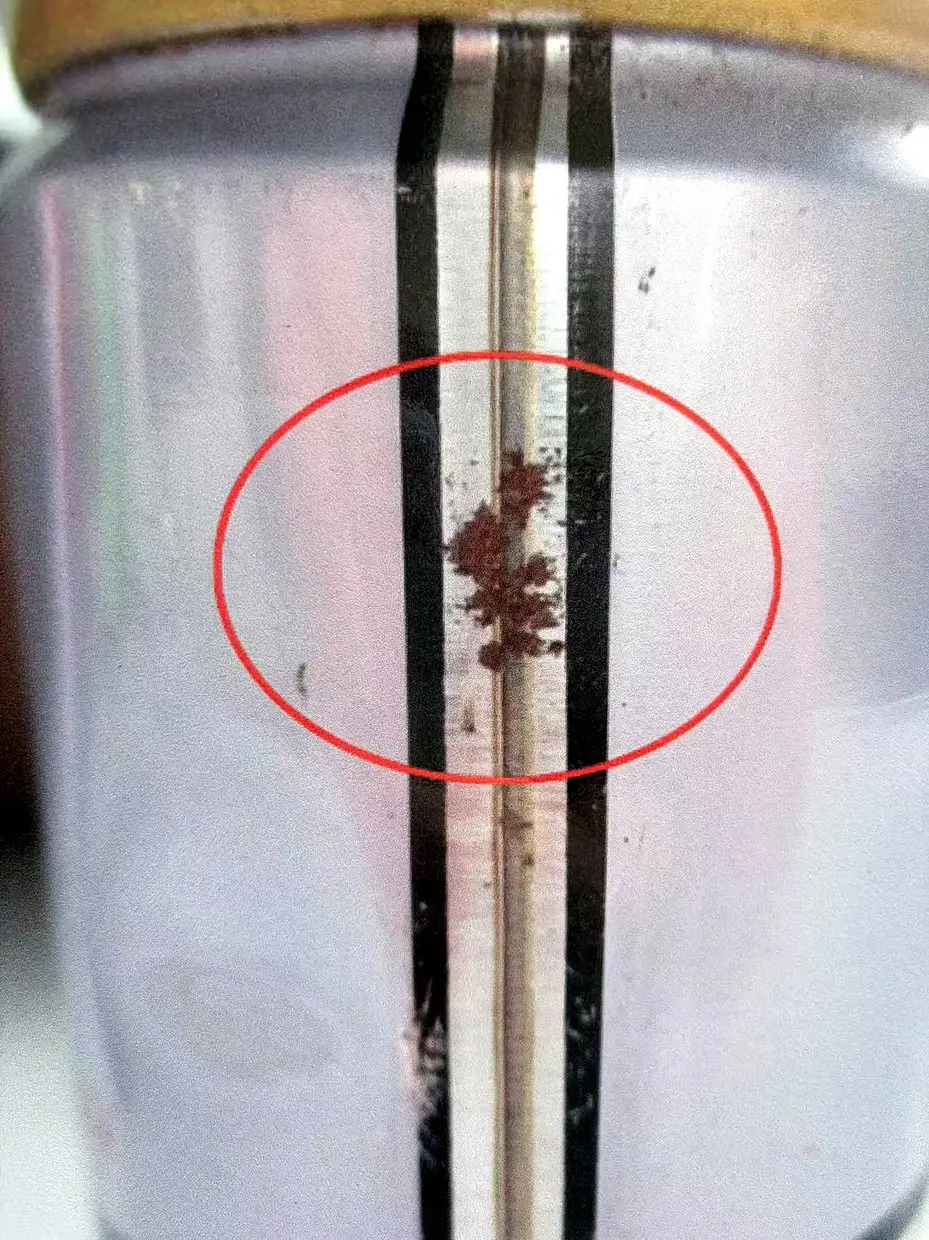
Handling clusters by exposure instead: the outer layer, the top layer, the face against the container wall. If the defect count drops as you go deeper into the pallet, it did not come from the factory, because the factory does not know which can ends up on the outside.
3. Is the damage on the skin of the load, or through it?
Scuffs that face outward on the outer layer are contact damage. The same scuff distributed evenly through the pallet — including on cans that were never exposed — is not, and no amount of careful packing causes it.
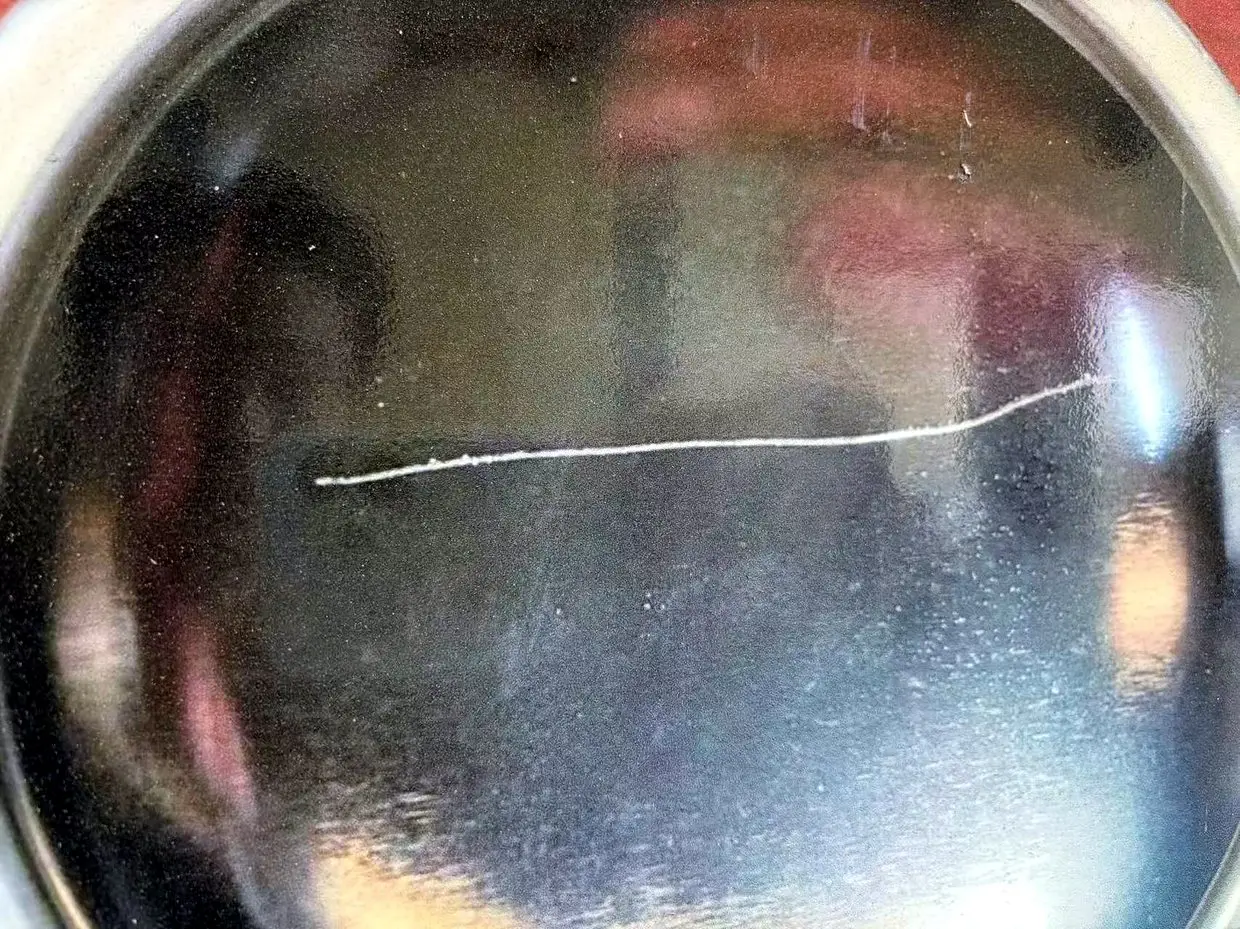
The distinction matters commercially because it decides who you write to. It matters technically because contact damage and process damage need different fixes, and a supplier who is asked to fix the wrong one will fix nothing.
4. Is there water, and where does it start?
Rust beginning at a cut edge, at the flange, or along an uncoated margin is a moisture story. Moisture in a sealed container is a voyage and storage event, even when the can maker’s coating is not perfect, and the useful question becomes who controlled the box and for how long.
Rust beginning in the middle of a lacquered panel, away from any edge, is a coating or lacquer defect, and the moisture only made it visible. Two different claims, two different remedies, and the position of the first rust spot tells you which one you have.
The packing spec belongs in the purchase order for this reason. Desiccant, liner, VCI, and whether the pallets are stretch-wrapped or shrink-wrapped all change the odds, and a supplier who shipped dry has a real defence. There is more on that in how to reduce rust and damage during ocean freight.
5. Could your own line have made it?
Depalletisers, unscramblers, infeed chutes, filler heads and valve crimpers damage aerosol tin cans at a rate that surprises most people who own them. The machines are fast, the cans are thin, and the damage they cause looks exactly like the damage a factory causes.
The test takes an hour. Run a thousand cans from the suspect batch through the line and inspect them at the outfeed. If the defect rate rises, the defect is yours, and you have just saved yourself a claim you would have lost.
Before you write to anyone, also look in your own reject bin. If the cans you threw away yesterday carry the same mark, the mark is not new — it is just newly noticed.
Where the freight boundary actually sits
Under FOB and CIF terms, risk passes to you when the goods are on board at the origin port. Under DAP and DDP it passes at destination. The same rust is therefore a supplier claim or a carrier claim depending on two letters in a contract that the person handling the claim has often never read.
It is worth knowing which one you bought, because it changes the answer to “who do I write to” before it changes anything about the cans. It also explains a pattern that otherwise looks like evasion: a supplier who answers a condensation claim with the bill of lading is not being difficult, they are pointing at the point where the risk moved.
Photographing a defect so the other side can verify it
The job of a defect photograph is not to show how bad it is. It is to let somebody four thousand kilometres away reproduce your finding with the same sample in their hand. That is a higher bar than “clear photo”, and most sets fail it.
Four frames per defect type
Not per can. Per defect type, with a count attached.
Frame one: the context. The pallet, the label, the batch code legible. This is what makes the claim traceable to a production record — without it, the supplier cannot check anything and will defend instead of investigating.
Frame two: the carton. Open, showing the position in the pallet and the condition of the packaging. This settles the question in section 1 above, permanently and without argument.
Frame three: the can, whole. The defect visible in the context of the entire container, so a reader can judge where on the can it sits. A close-up with no wide shot is a photograph of an unknown object.
Frame four: the defect, with a scale. A steel rule, a coin, a caliper jaw in frame. Without a scale, “a large dent” is an opinion, and opinions do not survive a second reader.
Six ways a photo set fails
- No scale, so size becomes a negotiation.
- No wide shot, so location becomes a negotiation.
- Shot with a phone flash on glossy lacquer, which turns every surface mark into a highlight and hides the one defect that matters.
- Shot under different light from the one used for inspection, which invites the reply that the defect does not exist.
- One can instead of a group, so a pattern that would prove a process cause looks like an isolated fault.
- Cropped so tightly that the reader cannot tell which end of the can they are looking at.
Photograph a good one next to it
The most persuasive image in a claim file is usually not the defect. It is the same view of a can from an earlier accepted batch, or of a sound can from the same pallet.
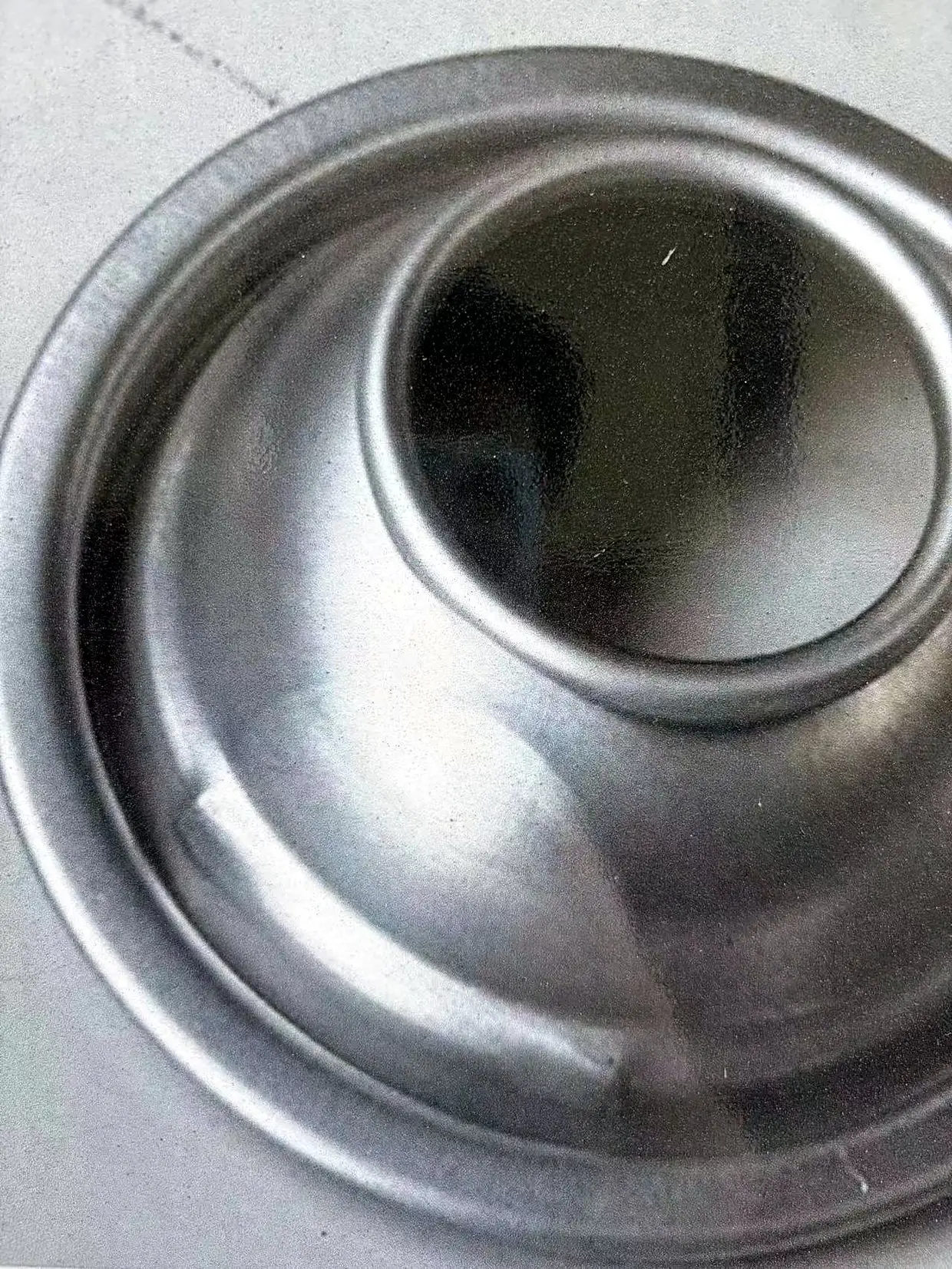
Adjectives invite disagreement. A control photograph does not. Take it while you are already set up, because you will not go back for it.
Keep samples, not just photographs
Thirty pieces per defect type. Bagged, labelled with the batch code, the date, and the initials of the person who pulled them. Sealed. Photographed in the bag with the label readable, so the sample in the supplier’s hand can be matched to the sample in your file.
Keep them until the claim closes and at least one more production cycle has run. The second failure is what proves a root cause was not fixed, and it is the difference between a credit note and a corrective action. Six months is a common contract minimum; longer is better and costs a shelf.
The claim, in the order it should go
The first message
Lead with facts that can be checked, in the order a production engineer would want them: batch code, quantity received, quantity inspected, defect name, grade, count found, rate, where in the load, packaging condition, photographs attached, samples retained, remedy requested, response date.
That is the whole message. Anything else — the line stop, the missed shipment, the customer complaint behind it — is context that belongs in a second paragraph, after the numbers, or in a phone call. A message that leads with consequences reads as pressure; a message that leads with a batch code reads as a record.
One more thing about names. Use the same name the other side uses. If their drawing calls it a compound skip and your report calls it missing glue, the first exchange will be about terminology and the second will be about whether you know what you are looking at.
What a can maker can actually do
It helps to know the menu before you ask for something that is not on it.
- Pull the production record for the batch, and the coil certificate behind it.
- Re-inspect the samples retained from the same shift.
- Sort at their plant before the next shipment goes out.
- Replace the affected pallets, identified by batch code rather than by quantity.
- Agree to a joint inspection, or to a third-party one.
- Issue a root-cause note with the corrective action and the date it took effect.
What they cannot do is make a rejected container arrive sooner, or undo a line stop that has already happened. Claims that read as though those two things were possible tend to stall, because the only honest reply is an apology.
Choosing the remedy
| Remedy | When it is the right one | Who pays freight | The catch |
|---|---|---|---|
| Credit note | Minor defects, low rate, you can use the cans | Nobody moves goods | You keep the cans and the risk that comes with them |
| Replacement by pallet | Major defects, clustered by batch or shift | Usually the maker | Time, and you must quarantine the old stock in the meantime |
| Sort and return | Major defects spread through the shipment, high value | Negotiated, often split | Freight both ways, and a second argument about the count |
| Run with 100% inspection | Minor or marginal defects you can catch at infeed | You | Labour, and every one you miss reaches a customer |
The mistake to avoid is asking for a remedy before you know the rate. “We want a replacement container” against a defect you found in one pallet invites a counter-offer of a credit, and the negotiation starts from a position you did not need to take.
The escalation ladder
Most claims settle at the fourth rung, and the first three exist to make the fourth credible.
- Written notice with the one-page report and photographs.
- Request for joint re-inspection, on samples you both hold.
- Third-party inspection if the two readings still disagree — the well-known firms are not cheap, and the cost usually lands on whoever was wrong.
- Debit note against the next shipment. This is the only lever with real cost attached, which is why it works and why it should be used once.
- The contract: governing law, arbitration, and everything nobody wants to read until they have to.
What the wrong grade costs, in numbers
Do the arithmetic before the argument, because the arithmetic usually decides it and it takes ten minutes.
Four costs belong in the comparison, and buyers habitually count only the first: the value of the affected cans; the labour to inspect, segregate and repack them; the line time lost if the defect reached the filler; and the freight to move anything in either direction.
The asymmetry that sets the grade
A credit on 3% of a pallet is a small number. One leaking can in a customer’s warehouse is not, because it arrives with a phone call, a photograph, and a question about the other nine thousand cans you shipped.
That asymmetry is the argument for grading on the worst case rather than the average. Price the defect at the point of failure, not the point of discovery. A crack that weeps in month three is a different commercial object from a scuff that is visible on arrival, even when both were found on the same pallet on the same morning.
When settling is cheaper than being right
If the disputed value is smaller than the cost of the inspection that would settle it, settle. Being right about three hundred dollars of cans and wrong about the working relationship is a bad trade, and it is the most common one in this business — usually made by someone who has not costed their own time.
The one-page report
If you take one thing from this article, take this structure. It is the difference between a complaint and a document.
Defect name: ______ (use the shared name — false weld, curl crack, compound skip)
Grade: critical / major / minor
Count found: ______ (rate: ______%, sample basis: ______)
Where found: outer layer / throughout / specific pallets: ______
Packaging condition: intact / damaged / re-taped
Photographs: context / carton / whole can / scaled close-up
Samples retained: yes, ______ pcs, location: ______
Requested remedy: credit / replacement / sort-and-return / run with inspection
Response requested by: ______
Eleven fields, twenty minutes, and it converts a disagreement into a work order. Send the same template every time. By the third claim, the supplier’s quality department will start filling in their half before you ask.
Questions buyers actually ask
Is a dented aerosol tin can end critical?
Usually not, and the location decides it. A dent in the flat panel of the end is cosmetic unless the lacquer has been broken. A dent at the shoulder radius, where the dome meets the body, can distort the double-seam seat and belongs in the major tier. A dent at the valve cup seat is major at minimum, because it will not crimp. Grade the location, not the size.
Our supplier says AQL 2.5 covers it. Are they right?
Possibly, and the purchase order decides. On a 24,000-piece lot, AQL 2.5 with a 315 sample accepts up to 14 defects. If you agreed that term, they are right about the arithmetic. If what you meant was that a cracked curl is never acceptable, that needed to be written as a separate line for critical defects with zero acceptance — and it still can be, on the next order.
Can we reject the whole container over a defect found in one pallet?
You can always reject it. Whether you can make it stick depends on the sampling plan and on whether the defect is critical. For a critical defect, yes: containment failure does not respect pallet boundaries, and the whole lot is suspect until sorted. For a cosmetic defect found in one pallet, rejecting the container is the fastest way to teach a supplier that your inspections are not worth reading.
Who pays the return freight?
Whoever the contract says, which usually means: the party at fault, and often only for the affected quantity. The practical answer is that return freight is rarely worth it. Empty cans are bulky, low-value per cubic metre, and cost more to move back than they are worth — which is why most claims on major defects end in a credit or a sort at the destination.
How long do we have to claim?
Whatever the contract says, and if it says nothing, whatever the local sale-of-goods law allows, which varies enough that it is worth asking a lawyer once rather than guessing every time. Sixty days from arrival, or thirty days from unpacking, whichever is later, is a workable commercial term and short enough that the batch records still exist.
Should we sort in-house or send them back?
Sort in-house when the defect is easy to see at infeed and the rate is low: you keep the good cans and the line running. Send them back when the defect needs a gauge to find, because a visual sort at your infeed will miss the ones that matter, and missing them is how a warehouse defect becomes a customer complaint.
When a claim reaches us
The first thing we ask for is the batch code, and the second is the photograph with a scale in it. Not because we doubt the claim, but because those two things are what let us look up the shift, pull the retained samples, and tell within a day whether the defect is ours.
If it is ours, the useful part of the conversation starts: which station, which shift, and what changed. If it is not, saying so with evidence is faster than saying so with sympathy.
For the defect-by-defect version of this — what each mark on an end or a seam actually is, photographed from our own rejects — see the top-to-bottom photo walk through end and seam defects. For the paperwork that sits alongside an incoming inspection, the import duty, documents and QC checklist for empty aerosol tin cans covers the part that happens before the pallet is opened.