

Editor’s note: this comparison is published by SAILON, an aerosol tin can manufacturer in Foshan that ships into Brazil through importers and, occasionally, directly to fillers who hold their own licence. We are route three on the list below, so read the rest with that in mind — but the arithmetic in the landed-cost section is the same arithmetic your despachante will run, and it is the part most suppliers never show you.
Brazil is the market where the most careful buyers still get the number wrong, and the reason is structural. Aerosol tin cans are a low-value, high-volume item: roughly 30,000 to 40,000 units in a 40HQ, each worth a few cents. That means freight and tax are not percentages on top of the product — they are the product. A buyer who compares an FOB price of USD 0.26 against a domestic quote of BRL 1.40 is not comparing two suppliers. They are comparing two tax structures and one cash-flow assumption.
So this is not a list of companies. It is a list of the six ways empty cans actually arrive in a Brazilian filling plant, what each one does to your unit cost, and where each one breaks. Most fillers end up using two of them at once.
In short
On a 65 mm printed can at USD 0.26 FOB, the landed cost inside Brazil typically comes out at 2.0–2.4× FOB before local freight. The can is less than half of what you actually pay.
The tax stack is sequential and grossed up: II, then IPI, then PIS/COFINS, then ICMS on a base that absorbs all three. Modelling it as “CIF plus 40 %” is how quotes get 20 % wrong.
The cheapest route at container scale is usually direct import. The cheapest route at your scale may be none of the ones your competitor uses — cash-to-stock, not price, is the deciding line.
How the six routes were compared
Five columns, because five things decide whether a route works for a given plant. Price is one of them and it is not the first.
| What we measured | Why it changes the answer |
|---|---|
| Duty and tax treatment | Mercosur-internal movement, direct import, and special regimes carry completely different stacks — the spread on identical goods can exceed 40 % of CIF |
| Who is the importer of record | Decides whether you need a licence, an import department, and working capital for the tax paid at clearance |
| Realistic minimum order | Cans are bulky; the minimum is set by container arithmetic, not by the factory’s goodwill |
| Cash-to-stock cycle | From payment to the can standing on your filling line. In Brazil this is often 90–150 days and it is the number that kills small programmes |
| Where it breaks | Every route has one characteristic failure. Knowing it in advance is worth more than a discount |
The six routes at a glance
| Route | Importer of record | Realistic minimum | Cash-to-stock | Best for |
|---|---|---|---|---|
| 1. Domestic converter | Nobody — it is a local purchase | One pallet | Days to 3 weeks | Urgency, small runs, no import capability |
| 2. Mercosur converter (Argentina) | You or your importer, duty-free intra-bloc | One truck or one container | 3–6 weeks | Buyers wanting a non-Chinese second source at moderate volume |
| 3. Direct import from China | You | One 40HQ (~32,000–40,000 cans) | 120–150 days | Programmes above ~250,000 cans a year |
| 4. Through a Brazilian distributor | The distributor | Ten pallets | 45–75 days | First entry, or volumes below one container |
| 5. Special regime (drawback / Manaus) | You, under a suspended or reduced stack | One container, plus a compliance project | 120–150 days | Fillers who export the finished aerosol |
| 6. LCL consolidation for a trial | You or your importer | 5–8 pallets | 75–100 days | Proving a specification before committing to a container |
1. Brazilian converters — the fastest route and the most expensive can
Tax treatment: domestic sale, ICMS credited normally, no import process.
Cash-to-stock: days to three weeks.
What they are good at: speed, credit terms, and being reachable when a line stops on a Tuesday.
Brazil has real can-making capacity, and for a filler buying 20,000 cans a month of a standard 65 mm body, a domestic converter is genuinely the right answer. The premium you pay is the price of not having an import department, not a markup anyone is hiding.
What they are not good at is variety at low volume. Ask for a six-colour design with a spot varnish across three diameters at 60,000 pieces each and you will either get a long lead time, a print minimum you cannot meet, or a polite suggestion that you standardise. That gap — design flexibility at small batch — is where imported cans win, and it is the only argument worth making in a price negotiation that you will otherwise lose.
Where it breaks: you inherit their capacity calendar. In a strong season, a domestic converter serves its largest accounts first, and a 60,000-piece order from a new customer is not the account anyone protects.
2. Mercosur converters — duty-free, but not capacity-free
Tax treatment: intra-Mercosur movement with the applicable origin documentation; no import duty, but ICMS still applies on the state movement and the paperwork is not optional.
Cash-to-stock: three to six weeks by road.
What it is good at: giving you a second source that is neither Chinese nor the same domestic converter everyone else uses.
Argentina has can-making capacity and a long history of supplying Brazilian fillers. For a buyer whose risk register says “do not depend on a single domestic supplier, and do not depend on a 40-day ocean leg either”, this route is the middle path — and it is chronically under-used because buyers default to either local or Chinese.
The constraint is not duty, it is availability and payment. Cross-border Mercosur trade inside South America carries its own documentation habits, and lead times quoted at the start of a quarter have a way of stretching at the end of it. Treat this as a second source with a real but slower response, not as a substitute for a domestic emergency supplier.
Where it breaks: origin qualification. A can made in Argentina from imported Chinese tinplate may or may not satisfy the origin rule depending on the tariff shift, and the answer decides whether you saved 14 % or paid it twice in professional fees. Get the origin position in writing before the first order, not after.
3. Direct import from China — the cheapest per can, and the longest cash cycle
Tax treatment: full stack — II, IPI, PIS/COFINS, ICMS on a grossed-up base, plus AFRMM on freight and the Siscomex fee.
Who is the importer of record: you, or a trading company acting por conta e ordem on your behalf.
Realistic minimum: one 40HQ. Below that, freight per can rises faster than the price advantage falls.
Cash-to-stock: 120–150 days from deposit to cans on the line.
This is the route we know best, so here is the case against it as clearly as the case for it. Direct import wins on unit cost at scale and on specification flexibility — you can choose the diameter, the coating system, the print and the pallet pattern, and nobody tells you to standardise. It loses on three things that no supplier can fix for you: the tax you pay at clearance is cash out of the business for six to ten weeks before you sell a filled can; one container is a large bet on a single SKU; and any quality problem is discovered 12,000 km away — usually as a rust bloom on a bottom rim after five weeks at sea, which is why our anti-rust packaging guide applies to the Santos lane as much as to Asia.
The way serious Brazilian fillers manage this is not by finding a better supplier. It is by splitting the programme: a domestic or Mercosur base load that covers the steady volume, and an imported layer that covers the growth, the new design, and the price benchmark. That structure survives a bad container. A single-source import programme does not.
Two structural details that decide your duty
The NCM. Empty aerosol cans sit under a heading that distinguishes cans to be closed by soldering or crimping from other cans of a similar capacity. Declaring the wrong subheading does not produce an ambiguous outcome — it produces the wrong rate, and a fine on the difference. Confirm the eight-digit code with your despachante before the proforma, and make sure the commercial invoice description matches the code rather than the marketing name of the product.
Who files. Importação por conta e ordem and por encomenda are not interchangeable. In one, the trading company is the importer and sells to you; in the other, you are the importer and it acts as your agent, which changes who holds the ICMS credit and who carries the liability for a misdeclaration. If a supplier offers to “handle the import for you”, ask which structure they mean. A supplier who cannot answer that question is not handling your import; they are guessing at it.
Where it breaks: the first container arrives before the specification is settled. Print a trial batch, ship it LCL, run it on the line, then commit to a container — that is route six below, and it is the cheapest insurance in this article.
4. Through a Brazilian distributor — you pay for the working capital
Tax treatment: they import and pay the stack; you buy domestically with ICMS credit.
Realistic minimum: ten pallets, sometimes less.
Cash-to-stock: 45–75 days, because the goods are already in the country or already ordered.
What it is good at: getting a new brand to market without an import licence, an import department, or 150 days of trapped cash.
The premium on this route is real and it is not theft — it is the cost of someone else financing a container, holding it, and taking the risk that you order again. Where buyers get hurt is at the point of specification ownership: if the distributor placed the order, the distributor owns the print approval, the coating spec and the complaint channel, and you may find yourself two steps away from the party who can actually fix a problem.
If you use this route, insist on three things in the supply agreement: the technical specification by name and revision, the right to be informed of any change in manufacturing source, and a sample-retention obligation for each lot. Those three clauses are what let you make a claim in year two.
Where it breaks: silent substitution. The can you qualified in month one is not always the can you receive in month nine, because the distributor is free to change supplier. A specification written against a drawing survives that; a specification written against a brand does not. The same logic runs through what a factory audit should actually test.
5. Special regimes — drawback and Manaus
Tax treatment: suspended or reduced. Drawback suspends II and IPI on imported inputs that are used in goods you export; the Manaus Free Trade Zone carries its own package of federal and state incentives for industrialisation inside the zone.
Realistic minimum: one container, plus a compliance project that costs more than the first container.
Best for: fillers who export a meaningful share of the finished aerosol.
This is the route that most foreign suppliers never mention, because it is the buyer’s project and not theirs. But for a Brazilian filler exporting to Latin America, drawback can remove the largest single line in the stack — and the difference between a suspended and a paid II is often larger than any price concession a factory can offer.
Two honest cautions. First, drawback is a commitment regime: you are undertaking to export, and the controls are auditable. Second, it rewards volume — the administrative cost is roughly fixed, so it makes sense on a programme, not on a container.
Where it breaks: the eligibility is discovered too late, after the can specification has been locked to a supplier who cannot provide the documentation the regime requires — quantities, NCM consistency, and a paper trail that matches your export declarations.
6. LCL consolidation, for the trial only
Tax treatment: same as route three, but with the fixed costs spread over far fewer cans.
Realistic minimum: five to eight pallets.
Cash-to-stock: 75–100 days, and the port handling is the unpredictable part.
Nobody should run a production programme through LCL. But almost everybody should run their first order that way. Five pallets of a printed can, landed in Santos, gives you four things a sample box cannot: the real print colour under your own lighting, the crimp behaviour on your own filling head, a genuine 50 °C container journey, and a cost per can you can show your finance director.
The premium over container freight is real — often two to three times per can — but it is being paid on 5 % of your annual volume, once. Compare that with the cost of discovering a neck dimension problem after a 32,000-can container has cleared customs.
Where it breaks: consolidation adds handling. Pallet corners dent, one carton gets wet, and the LCL terminal is not gentle. Specify corner boards and shrink wrap for an LCL trial even when you would not for a container, and photograph the pallets at handover.
The landed-cost stack, line by line
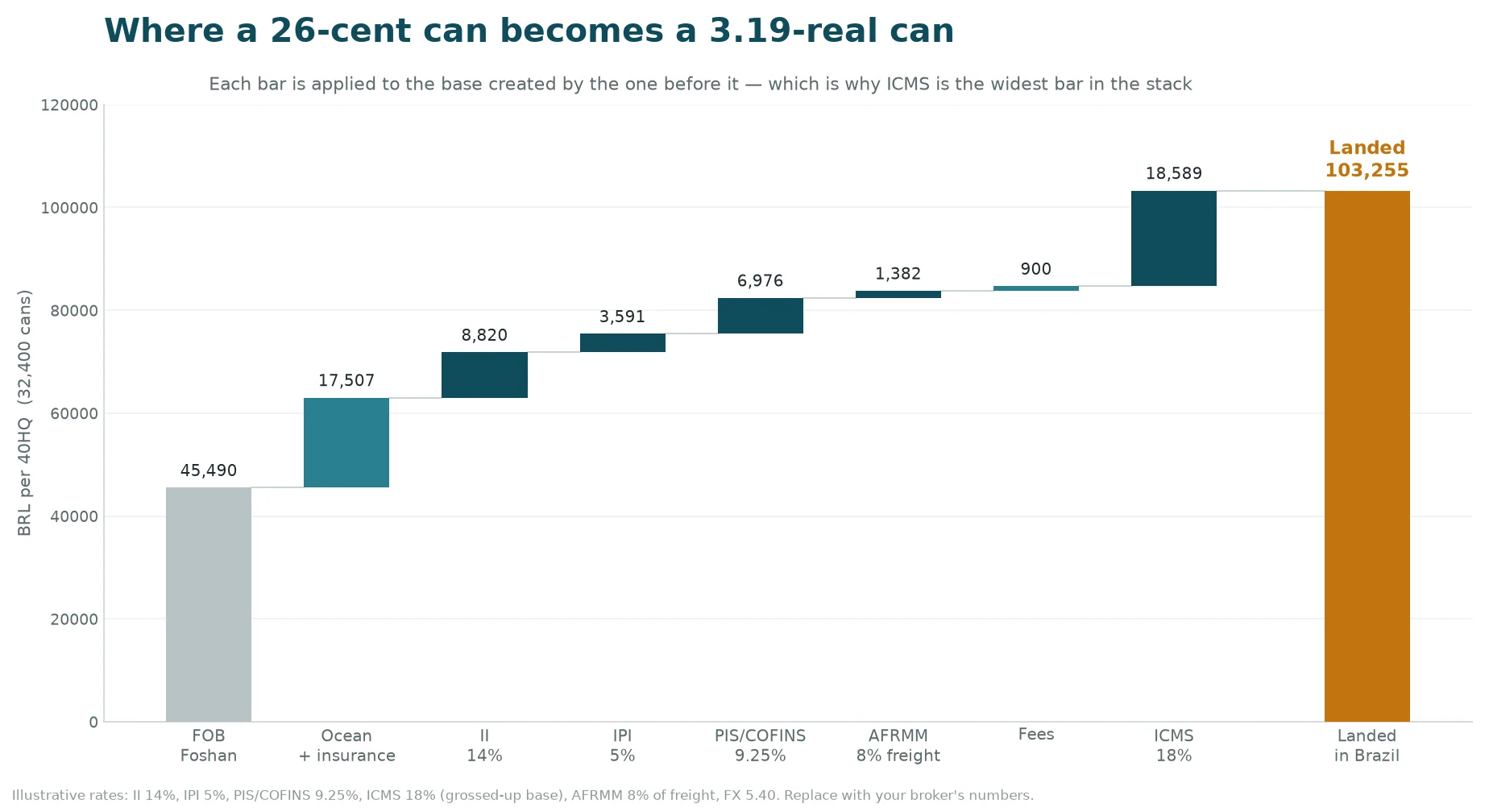
Worked example: one 40HQ, 32,400 printed 65 mm cans, FOB USD 0.26, freight USD 3,200, FX assumed at BRL 5.40. Every rate below is illustrative — replace them with your despachante’s numbers — but the sequence is not negotiable, and the gross-up is the part that catches people.
| Line | How it is calculated | BRL | Per can (BRL) |
|---|---|---|---|
| CIF value | FOB 8,424 + freight 3,200 + insurance ≈ 42, converted at 5.40 | 63,000 | 1.94 |
| II (import duty) | CIF × II rate (illustrative 14 %) | 8,820 | 0.27 |
| IPI | (CIF + II) × 5 % | 3,591 | 0.11 |
| PIS / COFINS-Importação | (CIF + II + IPI) × 9.25 % — 12.35 % in the standard 2026 case | 6,976 | 0.22 |
| AFRMM | 8 % of ocean freight only | 1,382 | 0.04 |
| Siscomex and clearance fees | Fixed per declaration, plus a broker fee | ~900 | 0.03 |
| ICMS-Importação | (CIF + II + IPI + PIS/COFINS + AFRMM + fees) ÷ (1 − 18 %) × 18 % | 18,589 | 0.57 |
| Landed, ex-port | 103,255 | 3.19 |
This is the same decomposition we set out in the five hidden elements of a can’s unit price, carried one step further into the destination country. Read the last two lines together. The can itself is 1.94 of the 3.19. The tax on moving it is 1.25 — nearly two-thirds of the CIF value — and the ICMS line alone, because of the gross-up, is more than II, IPI and PIS/COFINS combined. This is why “CIF plus 40 %” produces quotes that are wrong by a fifth, always in the optimistic direction.
The four mistakes that cost the most
Mistake 1 — Quoting per can instead of per filled unit
A can that costs BRL 3.19 landed and carries 400 g of product is a different proposition from one at BRL 2.60 that carries 350 g. Brazilian buyers are rightly obsessed with cost per filled unit; a supplier who quotes per can is answering a question nobody asked.
Mistake 2 — Ignoring the cash cycle
150 days from deposit to stock, with the tax paid at day 100, is a financing requirement. A programme that is 12 % cheaper per can and 60 days longer in cash is frequently more expensive for a mid-sized filler. Put both numbers in the same spreadsheet before you choose.
Mistake 3 — Designing a container around one SKU
A 40HQ of a single can size is efficient and fragile. Most experienced Brazilian buyers run two diameters in one container — 65 mm for the volume line, 52 mm for the range — which costs a little freight efficiency and buys a lot of commercial resilience. The sizing trade-off behind that choice is covered in 52 mm versus 65 mm.
Mistake 4 — Letting the artwork arrive late
Plates, colour proof and a signed master sample take two to three weeks. If they land after the container is booked, the ship sails and your cans wait for the next one. This is the single most common cause of a “late delivery” that was never a production problem.
What to put in the RFQ
Six lines. With these, any competent supplier can give you a landed-cost shape rather than a number that flatters itself.
- Diameter, can type (necked-in or straight-wall), height and target fill volume.
- Annual volume and first-order volume, stated separately — they usually justify different routes.
- Destination port and incoterm you actually want to buy on (CIF Santos and FOB are two different conversations).
- Whether you hold an import licence, and whether anyone in your business has run a drawback regime before.
- Print: number of colours, whether a physical master sample is required, and the artwork’s expected release date.
- Any regulated claim that will be printed on the can — because that is your ANVISA or INMETRO conversation, not your supplier’s, and it constrains the artwork timeline.
FAQs
Is it cheaper to import empty aerosol cans into Brazil or buy locally?
At container scale, import is usually cheaper per can — but not by the margin it appears to be, because the landed cost is roughly two to two and a half times FOB. Below about one container a year, the domestic or distributor route frequently wins once you cost the cash cycle and the import administration honestly.
What is the import duty on empty aerosol cans in Brazil?
It depends on the eight-digit NCM your broker declares, and the Mercosur common external tariff for that code. Do not accept a rate from a supplier — confirm it with your despachante against the current tariff, because the II is only the first of five layers and a wrong code invalidates the rest of your model.
How many cans fit in a 40HQ?
For 65 mm bodies, roughly 32,000–36,000 depending on height and pallet pattern; for 52 mm, 45,000–52,000; for 45 mm, upwards of 60,000. Ask for the loading plan per pallet layer, not a cubic-metre estimate — the difference between two plausible plans on the same container is often eight per cent of your freight.
Can a Chinese supplier handle the Brazilian import for me?
Not legally as your importer unless they have a Brazilian entity and a licence. What they can do is ship FOB or CIF, prepare documentation that matches your NCM and your invoice structure, and — usefully — tell you in advance what documentation the drawback regime will demand if you plan to use it.
How long does the whole cycle take, realistically?
From purchase order to cans on your filling line: 25–35 days production, 30–40 days ocean to Santos or Paranaguá, 7–15 days clearance, then inland freight. Call it 120–150 days, and add three weeks if the artwork was not final when the order was placed.
Which route fits your volume
If you are under 100,000 cans a year, route one or four; above 250,000, route three with a domestic base load; if you export the finished aerosol, route five is worth a project on its own; and whatever your size, route six once, before you commit.
We can tell you what a container of your specification costs FOB Foshan, what it weighs and how many units it holds — and, more usefully, which of these six routes other Brazilian fillers at your volume actually use. That conversation costs nothing and usually saves a container.
See the 45–70 mm range, check the size and fill-volume chart before you pick a diameter, or send your volume and destination port and we will come back with the container arithmetic.